Both details are answers to the same problem — the plain slip-on that needed one more idea — but they answer it in different media, and almost nobody says which. The horsebit vs tassel loafer question usually gets settled by vibe: hardware if you lean sleek, tassels if you lean rakish. The useful question is physical. An ornament on a shoe makes its noise in exactly one of two ways — through light, or through motion — and the bit and the tassel each committed to one and never wavered. Which reads quieter turns out to have a precise answer. It just depends on what you are doing when the room looks down.
What metal says, and when it says it
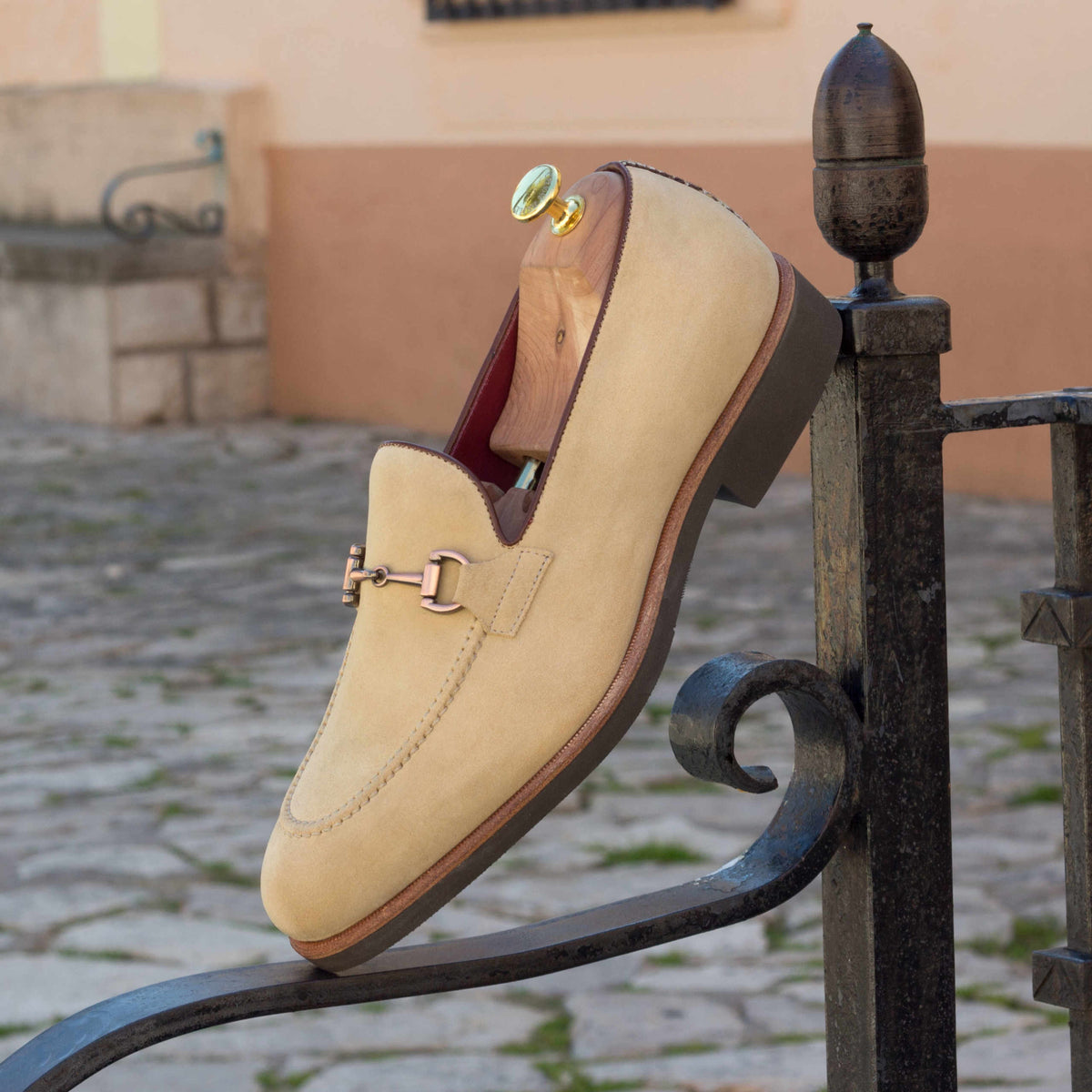
The bit is the only piece of metal most dress shoes will ever carry, and metal has exactly one voice: reflection. A polished snaffle bar laid across the vamp does nothing by itself — it waits for light, then speaks in one small, precise glint. Its heritage explains the stillness. Riding hardware, lifted onto a slip-on in Milan in the fifties and never meaningfully altered since, was built to be looked at, not to move — and that is still how it behaves. The bit is riveted stillness: it performs when you are still.
See it at work. Seated at a desk, legs crossed, the shoe held at speaking height, the glint is constant — a low, steady signal that reads as intent. Under direct sun it gets louder; against dark leather it sharpens into something brief and exact. But set the shoe walking and the bit all but hushes. A moving glint is small and quick, easy to miss — the eye reads motion first and metal second. The bit's whole register lives in stillness and light.
What leather does when it moves
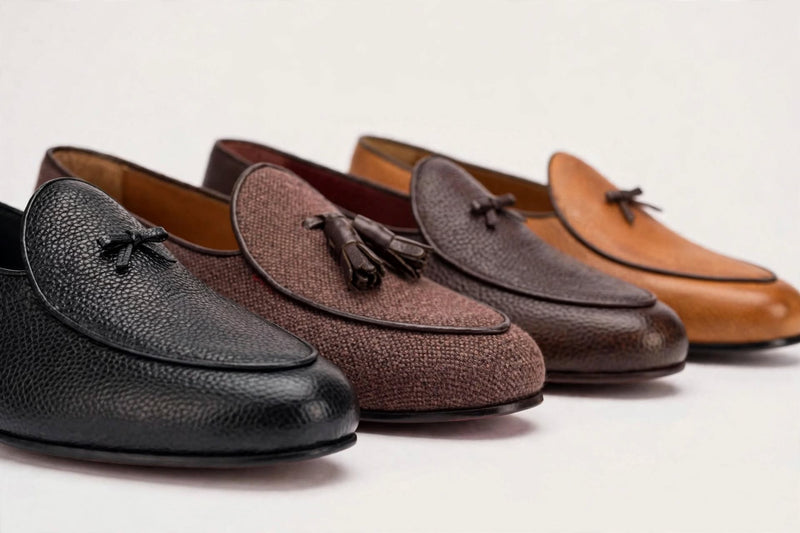
The tassel made the opposite commitment. Cut from the shoe's own hide or its own suede, it has no light of its own — matte leather against matte leather, nothing to reflect. Its medium is motion. Two tassels hung from the vamp swing at every step, fan and settle, and stop the instant you do. The lineage explains it: the tassel loafer came up through the American campus look of the late fifties, where it read as animation rather than status — the shoe that waved when you walked.
So the tassel is theater in motion and a shadow at rest. Stand still and it nearly disappears — two soft shapes hanging into the shoe's own silhouette. Cross a room and it performs the whole way. Where the bit addresses the room before you speak, the tassel performs as you pass through it — friendlier, less declarative, and impossible to notice without movement.

Where each one goes quiet
Now the title's question can be answered honestly, because it splits into two. Under light, at rest, the tassel is quieter — matte against matte, tonal, part of the leather it was cut from, while the bit holds its glint for as long as you sit there. In motion, the bit is quieter — a still object that nothing animates — while the tassels swing through every step of the room's attention. Evening adjusts the first half: in low warm light a tassel vanishes entirely, and the bit is down to one small glint, warm and brief.
Which is the whole answer, and it is a mirror more than a rule. The man whose day happens on his feet — moving through rooms, arriving, leaving — reads quieter in a bit. The man whose day happens seated, under light, at the head of a table, reads quieter in tassels. You are not choosing between loud and quiet. You are choosing which half of the day you want the silence in.
One spec sheet, two voices
Because the detail is the whole variable, it is exactly the kind of decision a made-to-order build was made for. In the design studio the bit is set as an accessory on a slip-on silhouette, and the tassels are laid onto the vamp as part of the loafer build itself — either one placed on the leather you choose, in the finish you set. Material decides the volume. Polished box calf turns the bit up; suede grounds it. Tonal tassels — navy suede on navy calf — all but whisper; a contrast pair speaks up. We made the full case for the bit in black on its own page, and the wider slip-on family — the penny's slot, the Belgian's bow, where each one lives — is mapped in the Belgian-vs-penny comparison.
However the spec is set, it is confirmed with you on screen before a single piece of leather is cut, and the pair is then built once, over about four to six weeks, with the full route laid out on the order process page. One ornament, placed on purpose, at the volume you chose — that is the entire argument for building the shoe rather than shopping for it.
The questions buyers actually ask
Are tassel loafers formal? Yes — at the structured end of the family. A polished-calf tassel loafer with a thin leather sole reads business-formal under a suit; the ornament animates the shoe without cheapening it. Read formality off the build — sole, structure, leather — not off the tassels.
Can you wear tassel loafers with a suit? Yes, and the physics favors it: a suit is still, so the one moving element on the whole figure is the swing of the tassels at the hem. Give the trousers a slight break and the motion reads as ease rather than flourish.
What is a horsebit loafer? A slip-on whose single ornament is a metal snaffle bar set across the vamp — riding hardware translated into a dress shoe, and the only metal most dress shoes will ever carry.
So which one is quieter — honestly? Neither, everywhere. The honest answer to horsebit vs tassel loafers is that the tassel is quiet at rest and the bit is quiet in motion, and each is at its loudest in the other's silent moment. Pick the half of your day that needs the silence.