
Open the shoe drawer of a man who owns both and they sit side by side like answers to two different questions — which, once you get past the internet's version of the belgian vs penny loafers question, is exactly what they are. The standard answer is decorative: the Belgian wears a small bow or a hanging tassel at the apron, the penny wears a leather strap with a slot cut in it. True, and beside the point. The real difference is structural — it lives in the throat of each shoe, in what sits under the vamp, and in the direction each one pulls a wardrobe. It is also the reason the pair were never actually rivals.
The signature everyone points at first
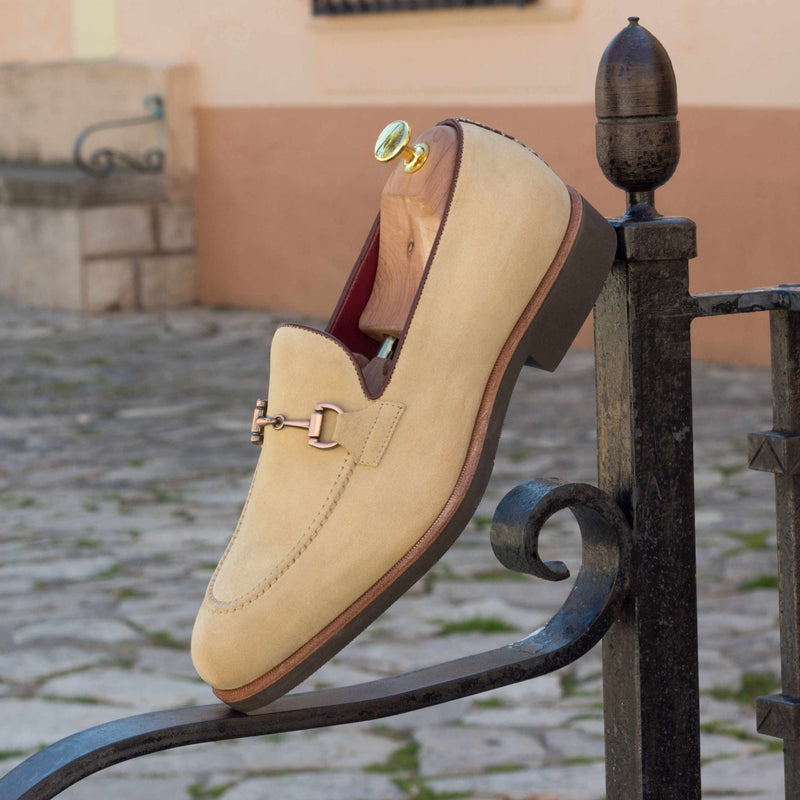
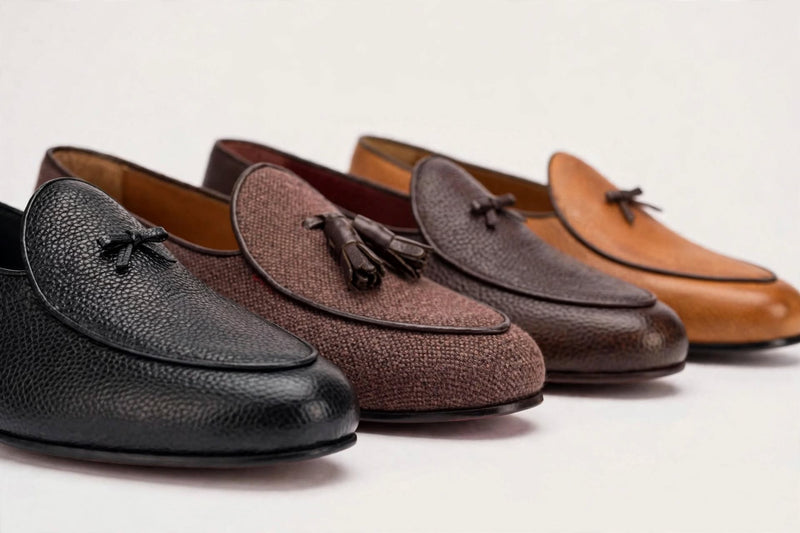
Start with the signatures, because they are how you tell the two apart at ten paces. The Belgian's is set low on the apron: a small flat bow with its tails pointing down toward the toe, or on some builds a tassel hung from a leather keeper at the seam's center — always cut from the shoe's own leather, never bolted on. The penny's is a saddle: a strap laid across the vamp and pierced by a diamond-shaped slit that gave the style its name. Bass built the original Weejuns in 1936 off Norwegian farm shoes, and the slit was pure decoration until American college students made it a coin purse — the story goes the penny was there for an emergency phone call, which is folklore, but useful folklore: it dates the shoe to the exact moment it became the campus shoe.
The Belgian's paper trail runs the other direction: not a work shoe dressed up, but a house slipper let out of the house. The accepted account credits Henri Bendel, the New York retailer who had the first pairs sewn in Brussels workshops after the war — soft, light, barely lined, a bow where a buckle would have been. That origin is the whole shoe's character compressed into one sentence, and it is why the two loafers diverge so completely beneath their signatures.

Where they actually split: the throat
Everything that matters sits under the vamp. A Belgian is engineered like a slipper that learned manners: a low, open throat the foot slides straight through, an apron cut soft and often barely lined, a featherweight body that folds to the shape of the foot instead of arguing with it. There is almost nothing built in to tension the instep, so the fit has to come from the cut itself. Wear one and the shoe is agreeable from the first hour — it creases where you crease, packs flat into a suitcase, and asks for essentially no breaking in, because there is almost nothing to break.
The penny takes the opposite engineering. Its saddle is not trim; it is a tension band laid across the instep, stitched down over a structured vamp that holds the shoe's architecture year after year. The classic builds are lined, welted and finished with a proper heel, and they age accordingly: defined creases, a polish that deepens, a shoe that keeps standing when it comes off your foot. It grips the midfoot through a day of actual walking in a way a Belgian never attempts.
That is the real difference in one line: the penny is tensioned, the Belgian is released. Every downstream disagreement between the two — formality, outfits, what feels better by Friday — is that single structural fork expressing itself.
Two directions, one wardrobe
Which explains the strange thing about the belgian vs penny loafers question: the shoes were never competing for the same slot. The penny spent the twentieth century pulling formality down into daily life — campus to office to business casual — until it became the most defensible dressed-down shoe a man could wear into a dressed-up room. In a rotation it replaces the derby and the chukka: the workhorse, the pair that takes denim, flannel and the Tuesday commute without a second thought.
The Belgian pulls the same rope in the opposite direction. It carries the ease of a house shoe up into rooms that expect proper ones — dinner tables, gallery evenings, weddings, and black-tie-adjacent territory when the body is velvet and the collar is piped. In a rotation it replaces the evening slipper and the occasion pair: the elevation move, the shoe that dresses an outfit up from below rather than down from above. One shoe made casual correct. The other made comfort formal. Asking which is better is a category error — they occupy opposite corners of the same slip-on map.
How made to order answers the fork
Off the rack, the fork is mostly theoretical anyway — a shop wall stocks whichever of the two its buyer guessed at, in one colorway, in the sizes that survived the season. The made-to-order route puts both in front of you as specs. The Belgian is the catalog's native slip-on family — body material from calf to velvet to suede, the apron, the piping, the bow or the hanging tassel, all set as part of the build — and the Belgian collection is where most loafer men start. The penny lives one level up, as a customizer spec: the structured slip-on with its saddle and slot placed where you want them rather than where a factory decided they go. Either way the sequence is identical — the full spec takes shape in the design studio, is confirmed with you before a single piece is cut, and the pair is then built once, over about four to six weeks, for one customer and nobody else.
And the fork rarely stays exclusive for long, which is the quiet answer to the whole question. The two shoes answer such different briefs that the men who commission one tend to come back for the other — the penny for the weeks, the Belgian for the evenings. Forced to a single pair, let your calendar make the call: the shoe that has to cover the most days is the penny; the shoe that has to make the few days count is the Belgian. For the background reading: why the Belgian's bow points down is the anatomy of its signature, and the complete 2026 guide to the family covers the builds, materials and rooms in depth.
The short answers
Is a Belgian loafer just a penny loafer with a bow? No — and that is the mistake the comparison invites. Swap the vamp decorations and the shoes still differ completely: the Belgian's low open throat and soft apron against the penny's tensioned saddle and structured vamp. The bow is the tell, not the difference.
Which one is more formal? Read them by direction, not rank. A penny reads business — correct under a suit, engineered for the hours between nine and six — while a Belgian in velvet with a piped collar walks into evening rooms the penny was never built for. Their formality points at different parts of the calendar rather than sitting higher and lower on one ladder.
Which goes better with jeans? The penny, on structure alone: a tensioned saddle and a welted sole ground denim in a way a slip-soft shoe cannot. The Belgian prefers tailoring — though in a soft suede body it will tolerate dark, unpatterned denim gracefully.
Do Belgian loafers ever carry the penny slot? No. The slot belongs to the saddle, which is the penny family's signature. The Belgian's apron carries a small bow with tails down — or a tassel hung from a keeper — cut from the shoe's own leather.
Can either one be made to order? Yes. The Belgian is the catalog's slip-on family — start with the Belgian collection or open the design studio — and the penny is buildable as a customizer spec. Either pair is confirmed as a full spec before anything is cut, then built once, over about four to six weeks.