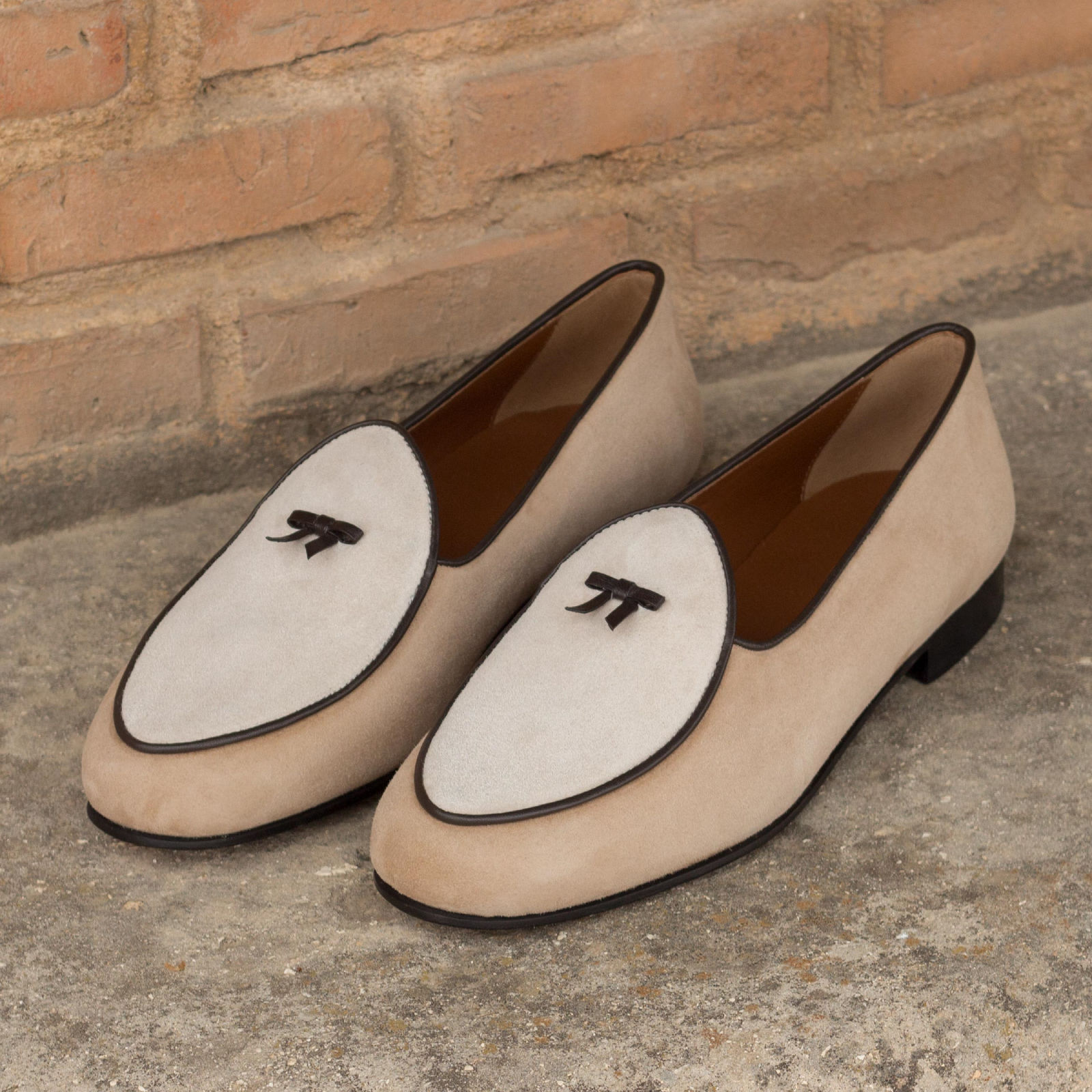
Every loafer has a signature. The penny loafer has its slot. The horsebit has its hardware. The Belgian has the strangest one of all: a small flat bow, tied neat as a gift ribbon, with its tails pointing down — toward the toe, away from the ankle. Few shoes wear their decoration so low, or so deliberately. And once you can name that detail, you'll start seeing it everywhere: on the feet of the best-dressed man in the restaurant, in old photographs of Palm Beach, on the cover of every "timeless style" list that matters. Here is what the shoe actually is.
What makes a loafer a Belgian
Strip the bow off and the skeleton underneath is still unusual. A Belgian loafer is an unstructured slip-on: no stiff toe box, no reinforced heel counter, no heavy sole unit. The upper — almost always a soft material like suede, velvet, or linen rather than polished calf — is sewn inside out, then hand-turned right-side-in once the seam is closed. The result hides every stitch and drapes over the foot like a house shoe that happens to be allowed outdoors.
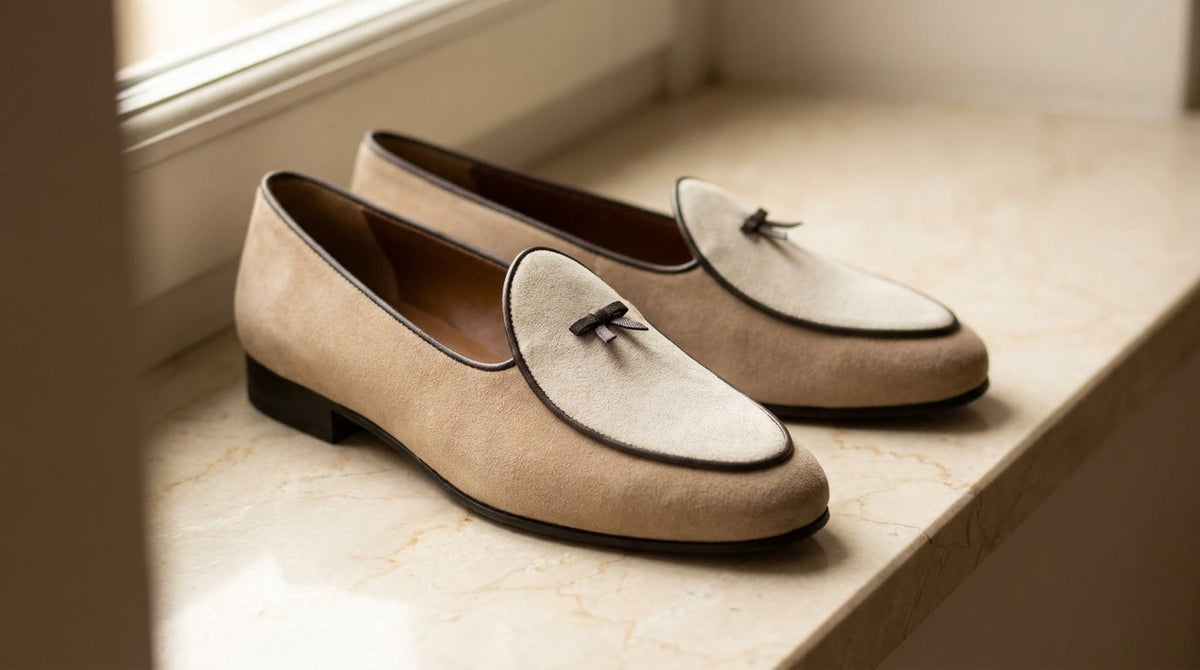
The rest of the anatomy is equally quiet: a low, slipper-like throat with a small oval apron panel over the vamp, a thin flexible sole, a stacked heel barely higher than a dancer's, and piping so fine it reads as a drawn line rather than a seam. It is the least armored dress shoe ever designed — and that softness is precisely why it survived.

Why the bow points down
Two things are true about the Belgian's bow. First: it is small — a couple of centimeters of flat leather, not a clown's tie. Second: the tails point down. This is not an accident of one maker's tying style; it is the signature orientation of the style, and it is the single fastest way to tell a faithful Belgian from a loafer that merely borrowed the idea.
The reasoning is practical. The bow sits at the bottom of the apron — the point where the oval panel's seam gathers and would otherwise end in a bare, unfinished edge. The bow is there to close that seam with a flourish. Set the tails pointing down and they lie flat along the toe, clear of the throat opening, where they never catch or fold when the shoe slips on. Point them up instead and they crowd the collar, rub against the instep, and fray. The Belgian's bow is not decoration bolted on — it is a working answer to a construction question, which is why the answer has barely changed in seventy years.
A short history
The style was created by Henri Bendel — the nephew of the founder of the Manhattan department store of the same name. In the mid-1950s, Bendel bought two centuries-old workshops in Izegem, a small town that is to Belgian shoemaking what Northampton is to English, and began producing the hand-turned loafer there. It landed in New York as a soft-soled antidote to the armored American penny loafer, and by the sixties it was the unofficial shoe of Madison Avenue and Palm Beach — the rare "WASP uniform" item that was also, genuinely, handmade.
The shoe then did what all quiet classics do: it receded from the mainstream and settled into connoisseur territory, worn by the sort of men who own it in multiples. The current menswear revival — soft tailoring, unstructured everything, comfort disguised as elegance — is essentially the rest of the world catching up to a design that never needed updating.


How to wear one
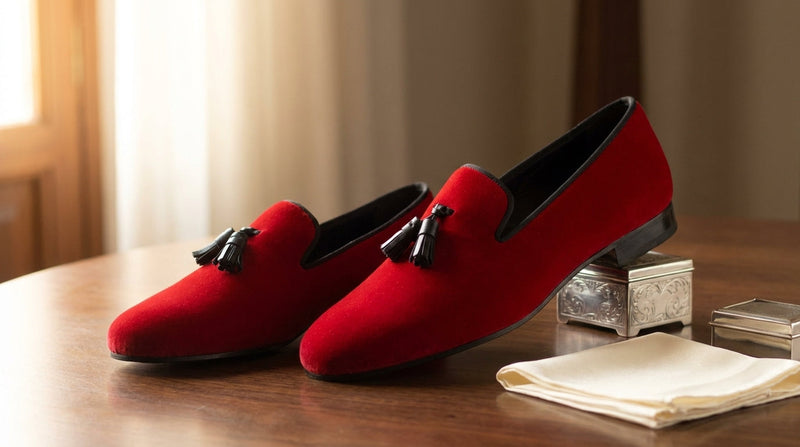
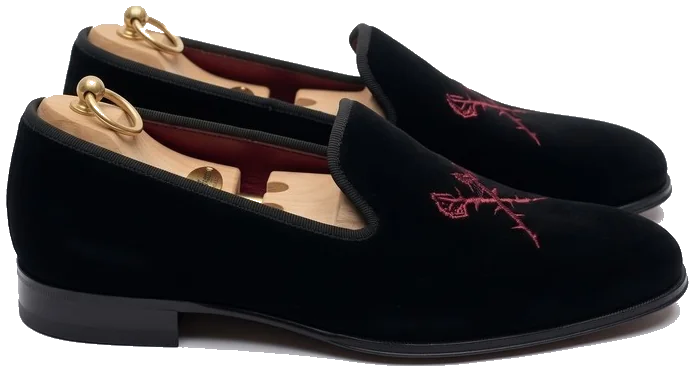
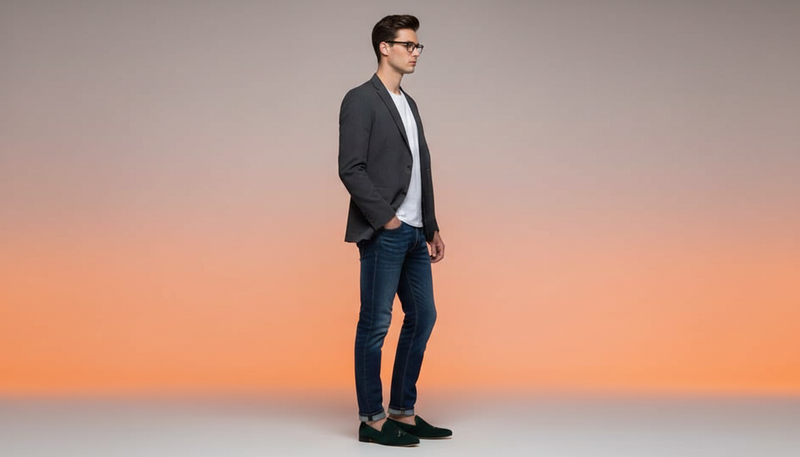
Because the construction is soft, the Belgian sits one notch more casual than a penny loafer but two notches more elegant. In suede it is a warm-weather day shoe — with cream or stone trousers, an unstructured jacket, no socks visible and no apologies. In velvet it crosses into evening territory outright, which is why grooms keep discovering it: it photographs like formalwear and feels like a slipper through a long day. The bow asks for restraint elsewhere in the outfit — let the shoe be the flourish and keep the rest quiet.
Design your own
Because the Belgian is a construction rather than a fixed product, it takes to customization naturally: the same turned upper can be cut in navy suede for one man, wine velvet for a wedding, or a two-tone ivory-and-taupe apron like the pair above. In the design studio you set the body material, the apron, and the trim, and watch the bow keep its place at the bottom of the seam. The Belgian collection page shows the silhouettes we build most often; the same shoe also happens to be the most frequent answer to the groom's footwear question. Every pair is made to order in Spain — four to six weeks from a confirmed spec, cut for one customer and no one else, with the spec confirmed before the cut.
Questions people actually ask
Is a Belgian loafer the same as a Belgian slipper? In practice the names are used interchangeably — "slipper" is the old New York term for the same soft, turned construction. Purists reserve "slipper" for the velvet evening versions, but the anatomy — apron, piping, down-pointed bow — is identical.
Is it a formal shoe or a casual one? Both, depending entirely on the material, which is the style's great trick. Suede reads daytime and relaxed; velvet reads evening. The construction stays the same.
Why does the bow point down and not up? Because the bow closes the bottom of the apron seam — the tails lie flat toward the toe, clear of the throat, where they neither catch nor fray. It is a working part, which is why faithful versions never reverse it.
How long does a made-to-order pair take? Four to six weeks from a confirmed spec. Each pair is cut for one customer — the spec is confirmed together before the cut, and once cut, the pair is yours alone.