Ask for a loafer in a size 14 and watch the salesman's face rearrange itself. A lace-up, he can manage — somewhere in the back room there is a cap-toe oxford in a 14 that has been sitting in its box since spring, and he will bring it out like a discovery. But the loafer table ends at 13, sometimes 12, and past that nobody even pretends to check. Of every shoe a big man gets refused, the loafer is the first and the least apologetic — and there is a mechanical reason for that. A loafer is the one dress shoe with no way to fake the fit.
A lace-up forgives. Extra volume disappears into the lacing; a narrow heel gets snugged by the last eyelet; the shoe and the foot meet in the middle and agree to call it fit. A loafer confesses. It is held on the foot by geometry alone — the cup of the heel counter, the tension of the throat — and when the geometry is wrong there is no strap to pull and no eyelet to loosen. It either fits, or it walks off your heel at the second stride. That honesty is why factories don't bother past 13, and why the few big loafers that reach the rack disappoint: stretching a smaller pattern solves the length and wrecks everything that makes a loafer worth wearing. Here is what a properly scaled pair of size 14 loafers demands — and where to find it.

Why size 14 loafers are the hardest thing to scale
Three things go wrong when a factory takes a loafer pattern drafted for the median foot and simply lengthens it. First, the heel counter. On a scaled last the counter is a cup, curved to hold the heel through the roll of a step; on a stretched pattern it becomes a ramp the foot climbs with every stride. That climb is heel slip — the most common complaint in big-size loafers, and no thicker sock ever fixed it. Second, the throat. The topline should sit against the instep like a fitted collar; lengthen the pattern and the throat gapes — a wedge of daylight no amount of breaking-in closes. Third, the apron — the seamed panel that rides the top of the vamp on a Belgian, with the tassel or bow anchoring it. On a longer vamp the seam migrates forward of the flex point, the spot where the shoe is designed to bend, so the loafer flexes where your foot doesn't and refuses to flex where it does.
None of these are exotic problems; they are drafting problems, solved at the last — the foot-shaped form the shoe is built around — before any leather is cut. The question that separates a real big-size loafer from a stretched one is a single sentence: was the last drafted for this size range, or scaled up from a smaller pattern? A last drawn for the bigger foot keeps heel cup, instep height, waist and toe taper in proportion — scaled, not stretched — and the difference is visible from across a room.
How to read a big-size loafer: heel to toe
Wherever you're buying — a specialist retailer, a European maker, or from us — walk the shoe front to back before you trust it. Start at the heel counter: press it, and a scaled last answers with a curve that wants to hold your heel, a stretched one with a flat wall. Move to the throat: it should lie against the instep the way a collar lies against a neck — flat, no daylight at the sides. Pass the waist, seen in profile: a proper extended last keeps it slim; a stretched one goes convex and clunky. Find the apron seam or vamp ornament and set it against your flex point — the crease where your foot bends; it should sit behind that crease, not on top of it. Finish at the toe: a size 14 loafer should still taper, quietly, the way the design intends. If the toe has gone wide and flat, the pattern gave up somewhere between 12 and your size, and no detail elsewhere in the shoe will un-tell it.
The loafer menu past 13
Here is the part the rack never shows you. When a store does carry one token shoe past 13, it is never a loafer — it is a black lace-up or a sneaker, the two silhouettes a buyer can sell to anyone. The loafer, with its dress-and-leisure in-between status, is the first style cut from the far ends of the size curve. Which means a big man shopping off the rack never learns the loafer is, if anything, his best-suited shoe: the ease of a slip-on with the finish of a dress shoe, the thing he actually reaches for when a lace-up is too much ceremony.
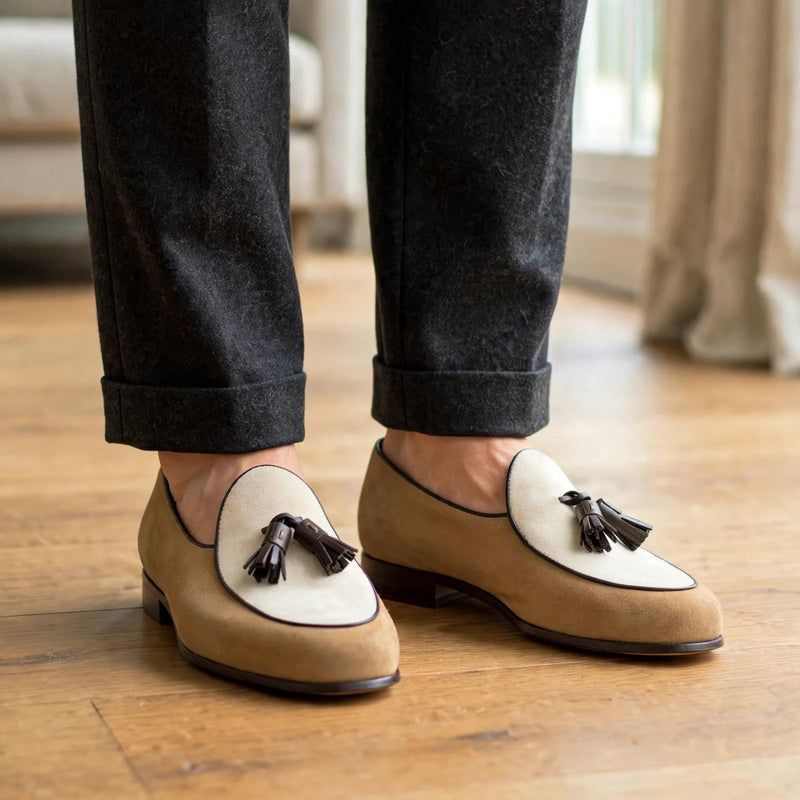
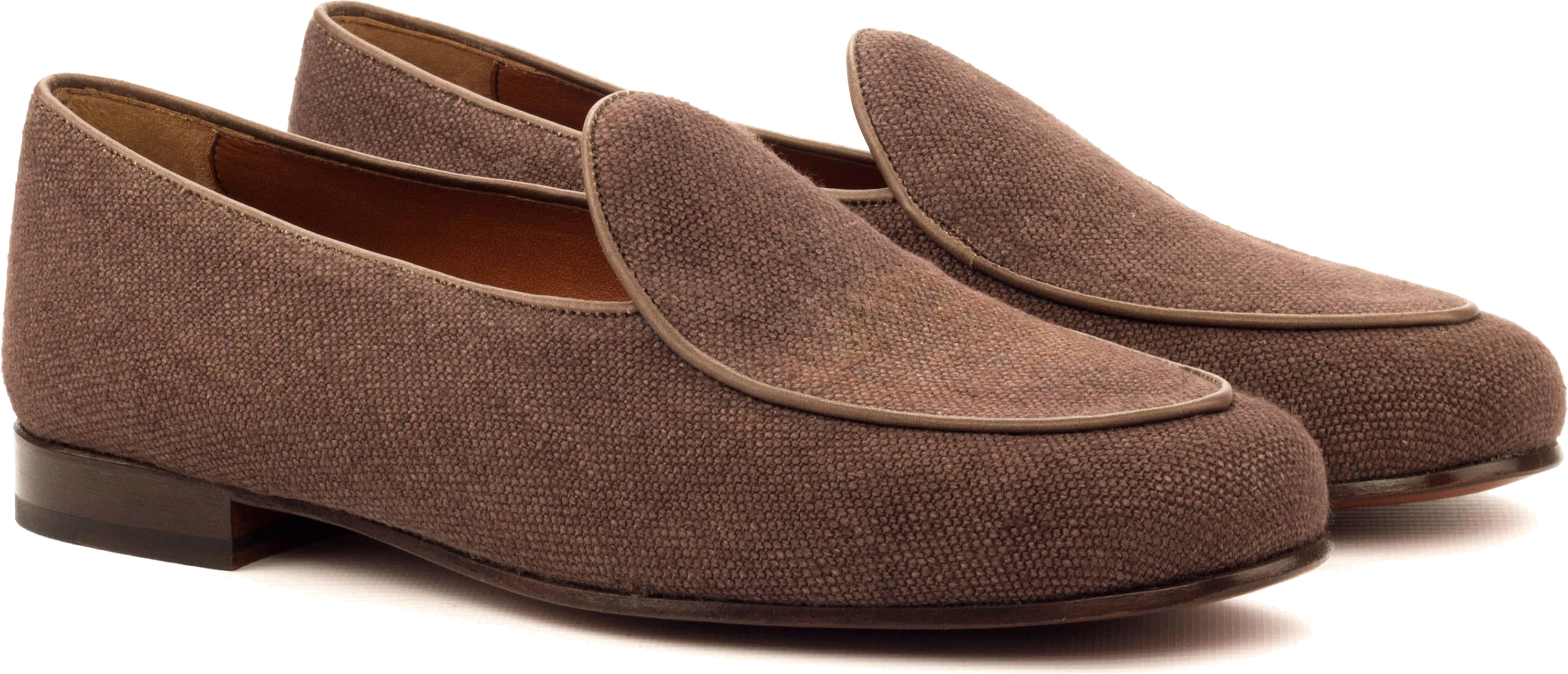
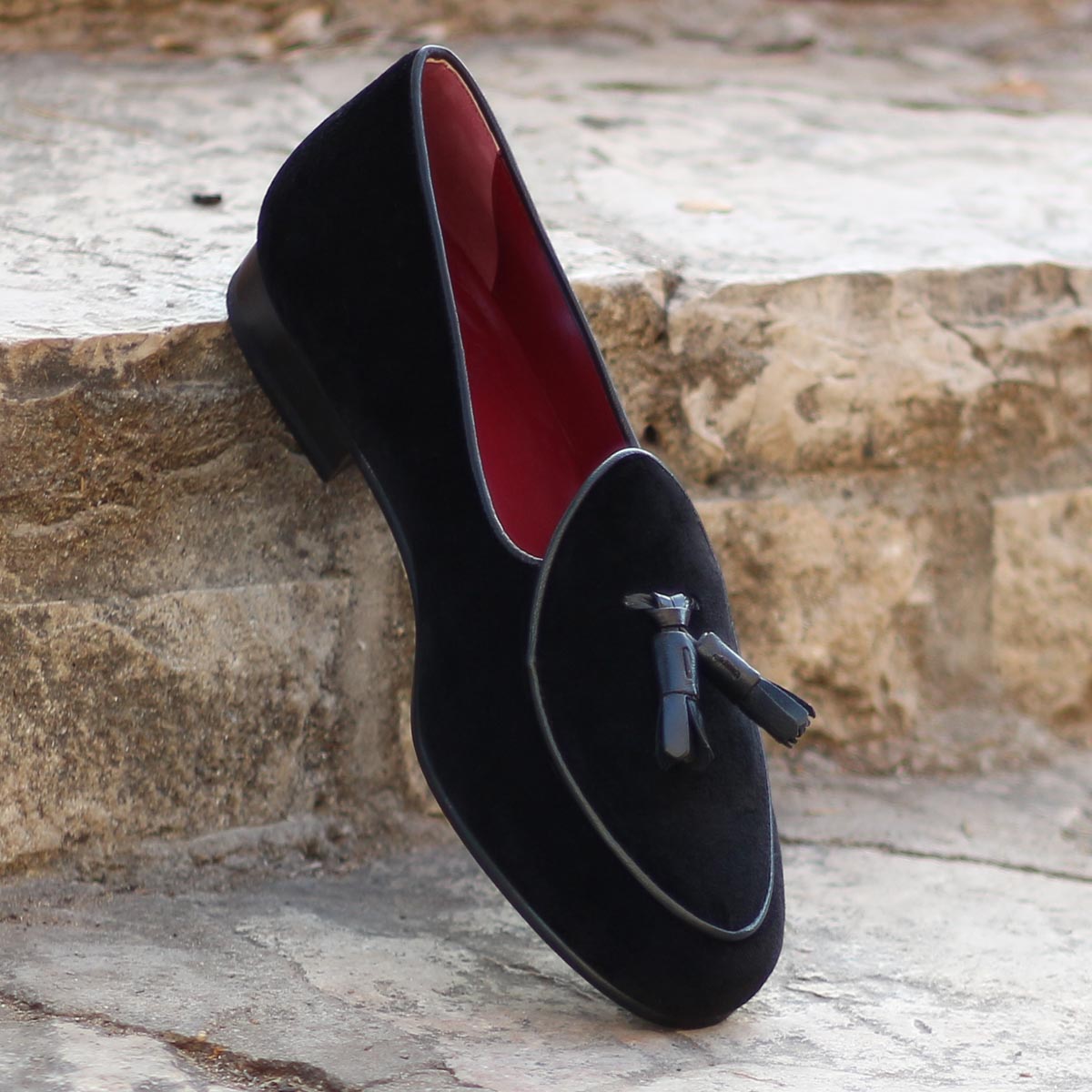
Made to order, the whole menu opens instead of one apology pair. Belgians — the slipper loafer with the flat bow or the hanging tassel, like the black velvet and silver-piped pair on this page. Tassel loafers in smooth calf or suede. Velvet slippers built for evening, suedes for the rest of the week, bit hardware for the horsebit men, and the colorways run the full catalog: blacks, navies, browns, the odd velvet or patina that no rack would ever gamble on in a 14. The option list is long on purpose. If your entire retail life has been we don't carry that in your size, the reversal is the point: the question stops being which compromise you'll accept and becomes which combination you actually want — the design studio lets you walk all of it before you commit to anything.
The honest constraint, stated plainly: each style carries its own size range. Some styles reach size 17 and 18; others stop earlier, and no single number covers the catalog. Widths run D and EE — and width and length are independent, so a 14 foot can be a clean D while a 10 needs EE. The exact range for the style you're building appears at the size selection step, before your order is confirmed — you'll never discover a ceiling after the money has moved.
Confirmed before the cut
The made-to-order route is short and plain. You pick the style, the leather, the colorway — the Belgian collection is where most loafer men start — then lock size and width at the size selection step, where the style's full range is shown. The complete spec is confirmed before anything is cut: the pair that arrives four to six weeks later is the pair you signed off on, built once, for one foot the industry spent decades telling to settle. The extended-sizing collection shows the range in one place; and if your search runs to lace-ups as well, we've mapped that road separately.
The questions big-size loafer buyers ask
Do size 14 loafers exist off the rack? Almost never as a planned range. The token big-size shoe at most retailers is a lace-up or a sneaker; loafers are the first style dropped when a buyer trims the ends of the size curve, because a size 14 loafer sits on a shelf longer than a 14 oxford ever will. What the big-size specialists do carry trends comfort-catalog. The loafer specifically is where off-the-rack gives up first — which is precisely why the made-to-order route exists.
Should I size up in loafers to stop heel slip? No. Heel slip on a large loafer is almost never a length problem; it's a last problem — the counter failing to cup. Going longer moves the flex point forward of where your foot bends, so the shoe breaks in the wrong place, the slip gets worse, and now the length is wrong too. The fix is last geometry and the right width grade, not a bigger number on the box.
What widths should a big loafer come in? D is the standard grade and EE is the wide grade most extended programs use. Never assume a long foot is a wide foot: plenty of size 14 feet are a perfect D, and plenty of size 10 feet need EE. A seller who assumes the two move together is telling you how much of the last he actually understands.
Which loafer styles run the biggest sizes? Ranges are set style by style, not store-wide — some of our styles reach 17 and 18, others stop earlier, and any seller quoting you one blanket ceiling is guessing. Each style's exact range appears at the size selection step, before your order is confirmed, so the ceiling is never a surprise after the fact.
How far ahead should I order a made-to-order loafer? Production runs four to six weeks from the confirmed spec. Order ahead of the season — or the wedding, or the gala — and the timeline stops being a risk and becomes the reason the pair fits: nothing was cut until your size, width, leather and colorway were locked first.