
Walk into any shoe store in America wearing size 14 feet and you already know what happens. The wall goes 7 to 13. The salesman's eyes do a quick arithmetic — your frame, your shoulders, the length of you — and arrive at the same apology every time: we don't carry that in your size. Not "we're out." Not "we can order it." The wall simply ends, and past size 13 you are expected to shop like a man the industry forgot. This article is about what actually exists past that wall — and how to buy size 14 dress shoes without settling for the three pairs the internet decides you deserve.

Here is the part nobody tells you: the demand has always been there, and the supply chain quietly agreed not to serve it. Retailers stock depth in sizes 8–12 because that's where the bell curve lives; everything past 13 gets a token SKU or nothing at all. The result is a buyer who is more motivated than the average shoe shopper — he's been told no his entire adult life — being handed options that are worse, not better: chunky comfort brands styled for orthopedics, or "big size" specialist sites where every pair looks like it was designed by a committee that gave up in 1997.
What "size 14 dress shoes" should actually get you
A size 14 foot is not a size 10 foot scaled up like a photocopy. When a factory takes a pattern drafted for the median foot and simply stretches it, you get the two classic big-size failures: a clown-scaled toe that reads costume, and a heel that fits like a boat because the volume was never re-proportioned. The difference between those shoes and a proper size 14 is the difference between stretched and scaled — a last (the foot-shaped form the shoe is built around) whose width, instep height, and toe spring were drawn for the bigger foot from the start. A correctly scaled size 16 reads as a size 16 should: same proportions, same elegance, more foot.
When you're evaluating any pair past size 13, look at three things before anything else. The last: does the toe taper like the dress shoe it claims to be, or does it widen into a flippers silhouette? The heel: does it hold your heel, or does the whole shoe balloon a half-size of volume behind your arch? The waist — the middle of the shoe viewed from the side: a proper extended last keeps a slim waistline; a stretched one goes convex and clunky. If a retailer can't or won't tell you whether the pattern was drafted for your size range, assume it wasn't.
Where retail actually ends
Be strategic about where you spend the search. Department stores: mostly dead past 13, except a handful that carry one or two made-to-order-capable bench brands. The big "wide and large" etailers: real inventory, but read the styling fine print . The selection is heavy on sneakers and comfort hybrids, thin on actual dress shoes, and what dress inventory exists trends toward the bulbous. European makers: superb scaling on the right styles, but stock depth past EU 49 (roughly US 14) is thin and restocks are slow. The honest summary: past size 13, off-the-rack means choosing between a shoe that fits or a shoe you'd actually be seen in. Rarely both.
The wall exists for a boring reason — inventory economics. A brick-and-mortar store must guess, months in advance, how many of each size to shelve. Sizes 8–12 sell fast and often; sizes 14+ sell slowly and rarely, so the buyer who needs them is exactly the buyer the rack cannot afford to serve. It was never evidence that big feet are rare. If anything, the data runs the other way. Searches for size 14, 15, 16 and up have steady, real volume all year, and the men doing those searches have already been rejected everywhere else. Motivated buyer, empty shelf: that gap is the whole opportunity — and it's the same gap we wrote about when we first opened the extended program.
How made-to-order changes the size 14 search
Made-to-order flips the shelf problem entirely. When each pair is built only after an order is placed, there is no rack to stock and no guessing game — the size range stops being an inventory decision and becomes a drafting question. Every style in our atelier is built on extended lasts, drawn for the bigger foot rather than stretched from a smaller pattern, in D and EE widths; size 17 and 18 are available on the right styles, and each style's exact range is shown at the size selection step, before your order is confirmed. You pick the style, the leather, the color; the pair is built once, for you, over four to six weeks, with the spec confirmed before anything is cut.
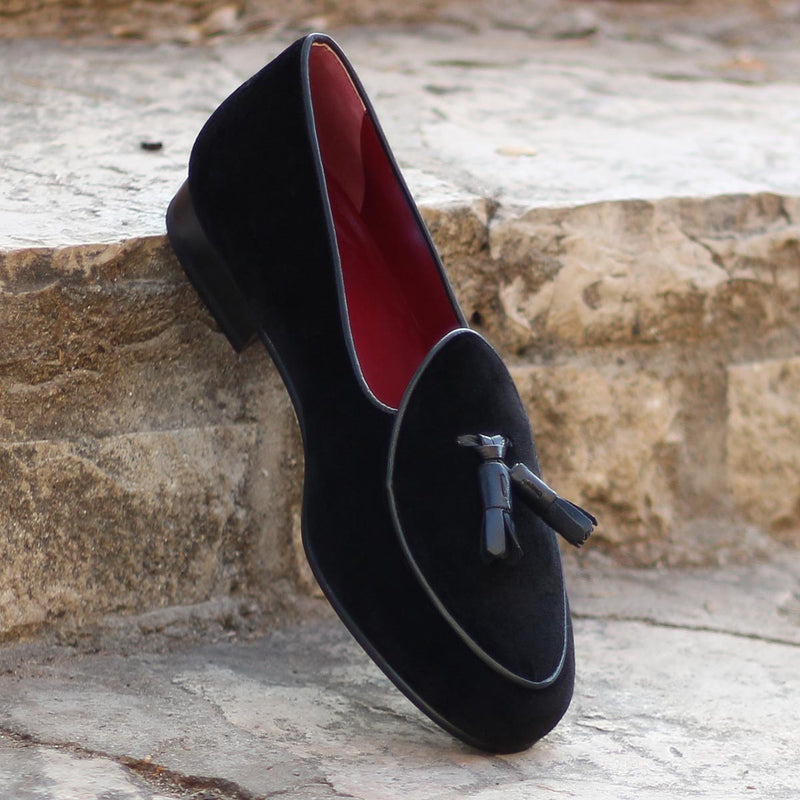
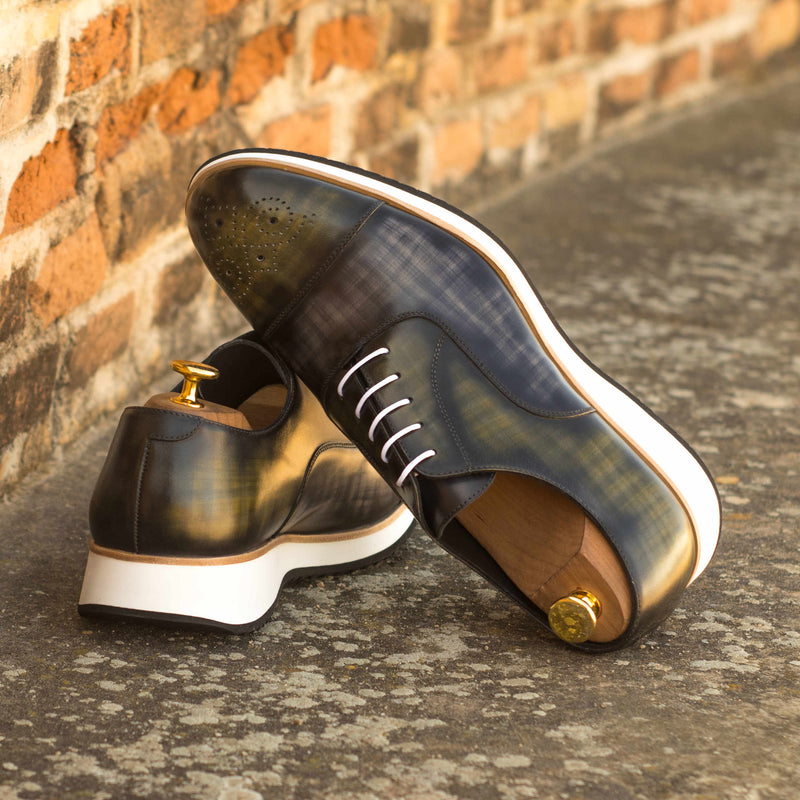
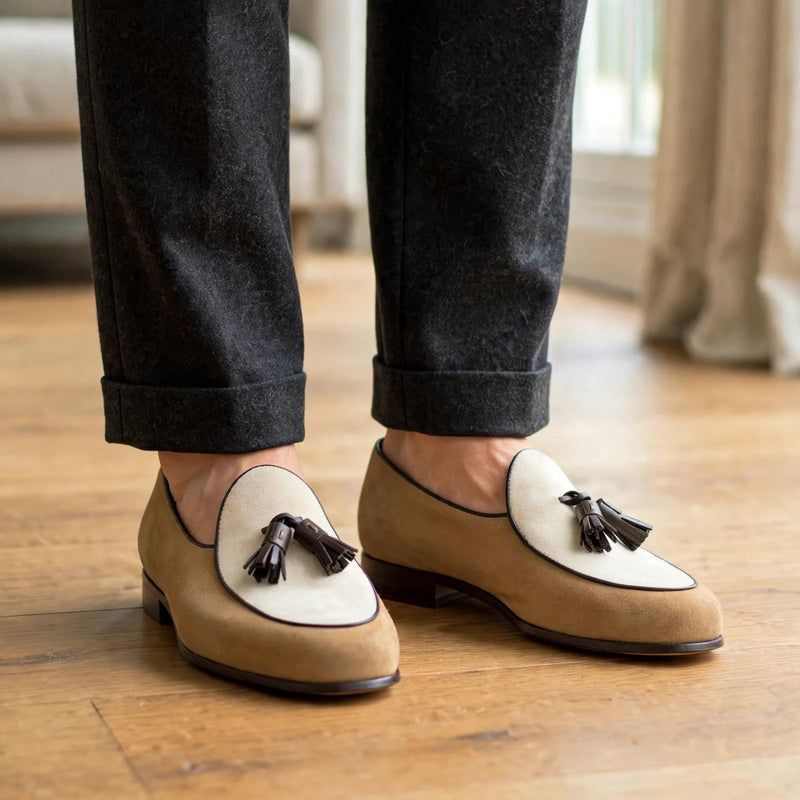
The part our big-and-tall clients mention most isn't the size, though. It's that the menu never runs out. Off the rack, a size 14 dress shoe shopper gets whatever three pairs survived the buyer's spreadsheet. Built to order, the same shopper stands in front of the full catalog — purples, patinas, and suedes among them — and the only question is which combination he wants, not which compromise he'll accept. If you've spent your retail life being handed the last box in the back, that reversal is the entire point. The extended-sizing collection shows what that looks like in practice; the design studio lets you walk the whole range of buildable options before you commit to anything.
And because the pair is confirmed before the cut — last shape, leather, color, size, width — there is no "we don't carry that" moment anywhere in the process. The wall, for once, is on the other foot.
Buying checklist: size 14 dress shoes
Wherever you buy — including from us — hold the seller to these five questions. Past size 13 they separate the serious from the stretched:
1. Was the last drafted for the extended range, or scaled from a smaller pattern? Ask in exactly those words. "Scaled, not stretched" is the answer you want; hesitation is the answer you'll usually get.
2. Is the width offered a true width system (D, EE, EEE) or just "wide"? A real width grade changes the last geometry. A marketing "wide" is usually the same last with more give in the upper.
3. What is the heel-to-ball relationship on your actual foot? A correctly fitting 14 places the ball of your foot at the shoe's break point — where it flexes. If the shoe flexes behind or ahead of that point, the last is wrong no matter what the box says.
4. What leathers are available in your size? If the answer is "whatever's in stock," you're back at the wall. Made-to-order should mean the full leather menu, not the leftover shelf.
5. What happens if the pair arrives and the spec is wrong? Know the policy before you order, from anyone. Ours is plain: if a pair arrives built different from the confirmed spec, it's remade at our cost. If it matches the spec you confirmed, it's exactly yours — which is the deal you make with made-to-order anywhere honest.
Questions people actually ask
Are size 14 dress shoes harder to find than 13? Dramatically. Size 13 is the last size most mainstream lines still cut with real depth; from 14 the mainstream assortment collapses to near zero, and what remains is concentrated at specialists and made-to-order houses. The selection isn't smaller because the feet are rare — it's smaller because the rack can't bet on you.
Do size 14 shoes cost more? Sometimes, and for honest reasons on both sides of the counter: more leather, more upper material, and lower production runs than median sizes. What should raise a flag isn't a fair premium — it's when the only size-14 option is also the ugliest shoe on the site. The tax you shouldn't pay is the style tax.
What widths should a big foot look for? D is standard; EE (a 2E grade) is the wide grade most extended programs use. But width and length are independent — plenty of size 14 feet are a perfect D, and plenty of size 10 feet need EE. Never assume a big length means a big width, in either direction, and never let a seller assume it for you.
Can I get size 14 shoes in styles other than basic black? Off the rack, rarely — the token big-size SKU is almost always the black or brown cap-toe. Made to order, the range widens to the full line: patinas, suedes, loafers, monks, boots. The colorway on this page — a purple patina oxford — is exactly the kind of pair the rack never offers past 13.
How do I know the fit will be right ordering online? The spec-confirm step exists for exactly this: your size and width are locked with the full spec before anything is cut, and each style's range is visible at the size selection step, before you confirm. Ordering blind is what the wall forced you into; confirming before the cut is what made-to-order replaced it with.