Every December, the same quiet scramble. The invitations start landing — drinks on the eighth, the office party on the twelfth, Christmas Day itself — and the shoes that carried the rest of the year turn out to be wrong for all of them. The brown loafers are too quiet. The black oxfords are too severe for half the rooms. And so begins the annual last-minute hunt for Christmas party shoes, which almost always ends one of two ways: a panicked December purchase that reads exactly like one, or a safe black pair that vanishes in every photograph. There is a third way. It requires acting before the season asks for anything, and it ends with tartan on your feet.

The season that breaks the rotation
Party season is the hardest brief on a man's calendar because it refuses to hold a single dress code. The same four weeks contain a smart-casual office party, a Christmas Day table that wants formality without stiffness, and at least one evening thing that wants actual festivity. No single shoe in the standard rotation covers all three — the rotation was built for offices and weddings, for rooms with predictable light.
Party rooms have unpredictable light. By six in the evening it is low, warm and close — candles, string lights, a dimmer someone thought was festive — and shoes chosen to look correct under daylight simply disappear in it. What survives after dark is texture and pattern. A shoe with a woven check on it is doing something at midnight that a plain black derby has never once done: holding attention in a room where every other pair of shoes has gone dark. That is the case for tartan as the December move, and it holds at every room on the circuit.
Why the pattern holds up after dark
Tartan works in party light for a mechanical reason: it is a pattern with a dark ground. From across a room, a navy-based check resolves as texture, not costume; at handshake distance it resolves as pattern. Warm light doubles the effect — it flattens solid leather into a single tone, but keeps moving across an intersecting weave. And because a patterned shoe takes the festive burden off everything else, the outfit above it can stay in the register you already trust: solid navy or charcoal, no novelty knit required. Deliberate at every distance is the whole formula.
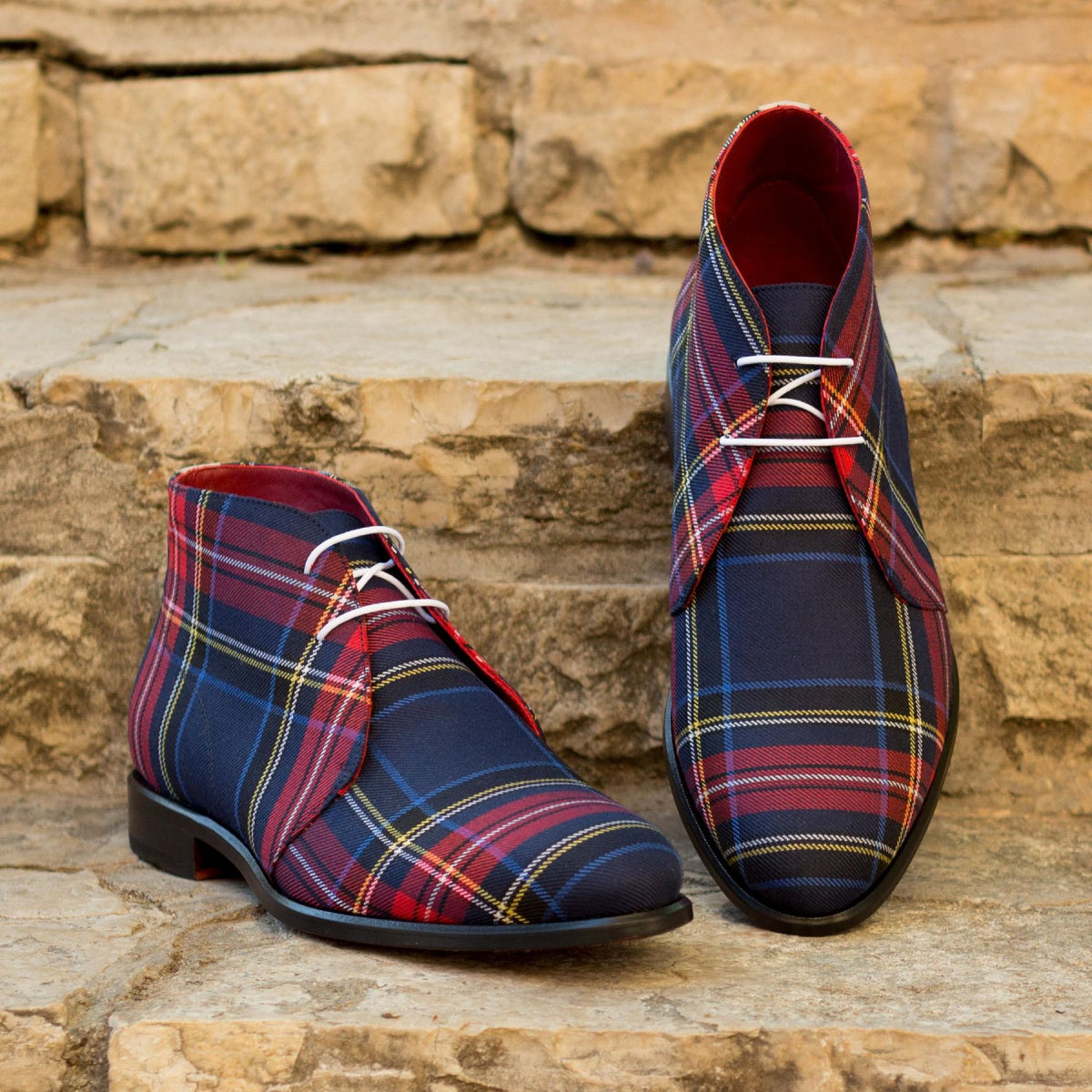
The pair in the photograph makes the argument concretely. A woven check over the vamp, quarters and collar, interrupted by an ivory suede toe cap that softens the shoe exactly where the eye lands; red piping tracing the collar and the seam where pattern meets suede; a red lining that shows only when the shoe moves. It is a chukka — ankle height, four eyelets, a thin black sole — which is the correct silhouette for the season for reasons a slip-on cannot match: it stays put through a night of standing, it takes winter pavement on the walk in, and it sits properly under the flannel trousers December deserves. Where the check sits, how much of the upper it covers and what frames it are all spec decisions — the kind you confirm on screen in the design studio before anything is cut.
The move is the calendar
Here is the part that separates the Q4 move from a December panic. A made-to-order pair is built once, to one confirmed spec, over about four to six weeks. That timeline is not an obstacle — it is the deadline. Every pair of Christmas party shoes worth wearing shares one trait: it was ordered before the season asked for it. The wrong move is waiting until the invitations arrive. The right move is counting backward: take the first party you actually care about and stand about six weeks in front of it. That is the order window, and right now it is open.
Order inside the window and the pair arrives with the whole circuit still ahead of it — built, delivered, and already walked in, which matters for shoes in a way it matters for nothing else you will wear this season. The men who order in the first week of December get a pair that lands when the season is half over, or they get nothing made for them at all and buy whatever the shop wall has left at 6 pm on the 23rd. If you have ever worn a pair of regrettable party shoes to an office party, you know how that story ends. The calendar move makes it unwritable.
One pair, three rooms
The economics of the move are better than they first look, because a patterned pair covers the entire circuit rather than one room.
The office party. Navy or charcoal suit, knit tie or none. The check at your feet is the entire gesture — it supplies the festivity so nothing else has to, which is the only dignified way to dress for people who read your out-of-office replies all year.
Christmas Day. Mid-grey flannel trousers and a fine-gauge knit. The ankle height holds the formality a family table wants without any of the stiffness, and in the one room on the circuit with daylight on your side, the pattern reads warm rather than loud.
The week between. Dark, unpatterned denim and a proper overcoat, for the loose stretch of days when nothing is scheduled but something always is. This is the test most party shoes fail — they are too ceremonial to leave the house in. A navy-grounded check with suede at the toe passes it easily, because it was never a costume. It is just a shoe with something going on.
Solid trousers at every stop — that is the whole discipline. Pattern at the feet wants quiet cloth above it.
Spec the pair before the cut
The made-to-order route is the reason this plan is worth making. The silhouette comes first — chukka, loafer, oxford — and the pattern works at every height, each carrying it differently. Then the decisions that make the pair yours: where the check sits and how much of the upper it covers, what frames it — an ivory suede toe cap like the catalog pair above, or painted calf, or both — and the piping color that traces the lines. Every one of those decisions is confirmed on screen in the design studio before a single piece is cut, and the pair is then built once, over about four to six weeks, for one customer.
If the pattern is new to you, the background reading is worth ten minutes. Tartan has been carrying formal occasions all autumn — the full case for it at weddings is here, and the suit-pairing guide covers how the pattern sits against grey flannel and navy. The December angle is simply the loosest and most enjoyable of the lot: party rooms are where a check is most at home, because party rooms are where a plain shoe is most lost.
So — the invitations are coming, even if none has landed yet. The move is to answer them early: one pair, spec'd on screen, built once, on your feet before the first Thursday drinks. That is what Christmas party shoes look like when they were planned rather than panicked over — quiet trousers, pattern at the feet, and a December that never once required an emergency purchase.
Before the first invitation
When is too late to order for the parties? Count back from the first event you care about, not forward from today. The build runs about four to six weeks to a confirmed spec, so the window closes roughly six weeks out — a pair ordered inside it is a pair that arrives to a season already half spent.
Is a tartan shoe too loud for an office party? Not a navy-grounded one. From across the room the check reads as texture rather than costume; up close it reads as intention. Keep the trousers solid and the rest of the outfit quiet, and the shoe does the talking without raising its voice.
What do I wear them with besides a suit? Mid-grey flannel and a knit for Christmas Day; dark, unpatterned denim for the loose week. The rule is constant: matte, solid cloth above the ankle, so the pattern at the feet is the only thing moving.
Do they stop being party shoes in January? No — seasons are an outfit's job, not a shoe's. The navy ground keeps the pair in year-round rotation, and the same check that read festive under string lights reads simply like a character shoe in March. Very few December purchases survive February. A made-to-order patterned pair is built to be one of them.