Two words stop nearly every man the first time he specs a dress shoe: box calf and patina. One sounds like a material, the other like a mood, and together they hold the single most consequential surface decision in a made-to-order oxford — the one the ready-to-wear wall made for you years before you cared. The box calf vs patina question is not, strictly, a choice between two leathers. Both begin as the same full-grain calfskin. It is a choice between two philosophies of the surface: one finished to a uniform glass at the mill, the other painted by hand at the bench into a gradient no second pair will ever share. Choose wrong and the shoe still fits — it just says something you didn't mean.

What box calf actually is
Box calf is the classic. A firm, smooth, tight-pored calfskin finished to take a high, even polish — the "box" is the old trade word for that boardy, structured handle, the leather that stands up on the last and holds its architecture for years. Run a hand across it and the surface answers like glass over stone: uniform, cool, closed. In black it is the most formal shoe leather in existence — the one the funeral and the boardroom have shared for a century. In espresso, oxblood or dark chestnut it keeps the same precise register, one remove warmer.
Its character is consistency. One color, one note, and a shine that goes as deep as your discipline — box calf takes a true mirror glow on the toe, which is half the reason it owns the formal column. Over the years it creases in defined, sharp flex lines rather than shattering, and under steady care it slowly deepens on its own: a quiet darkening at the edges that old-school shoemen prize. What it will never do, unaided, is surprise you. That is the point of it.
What patina means at the bench
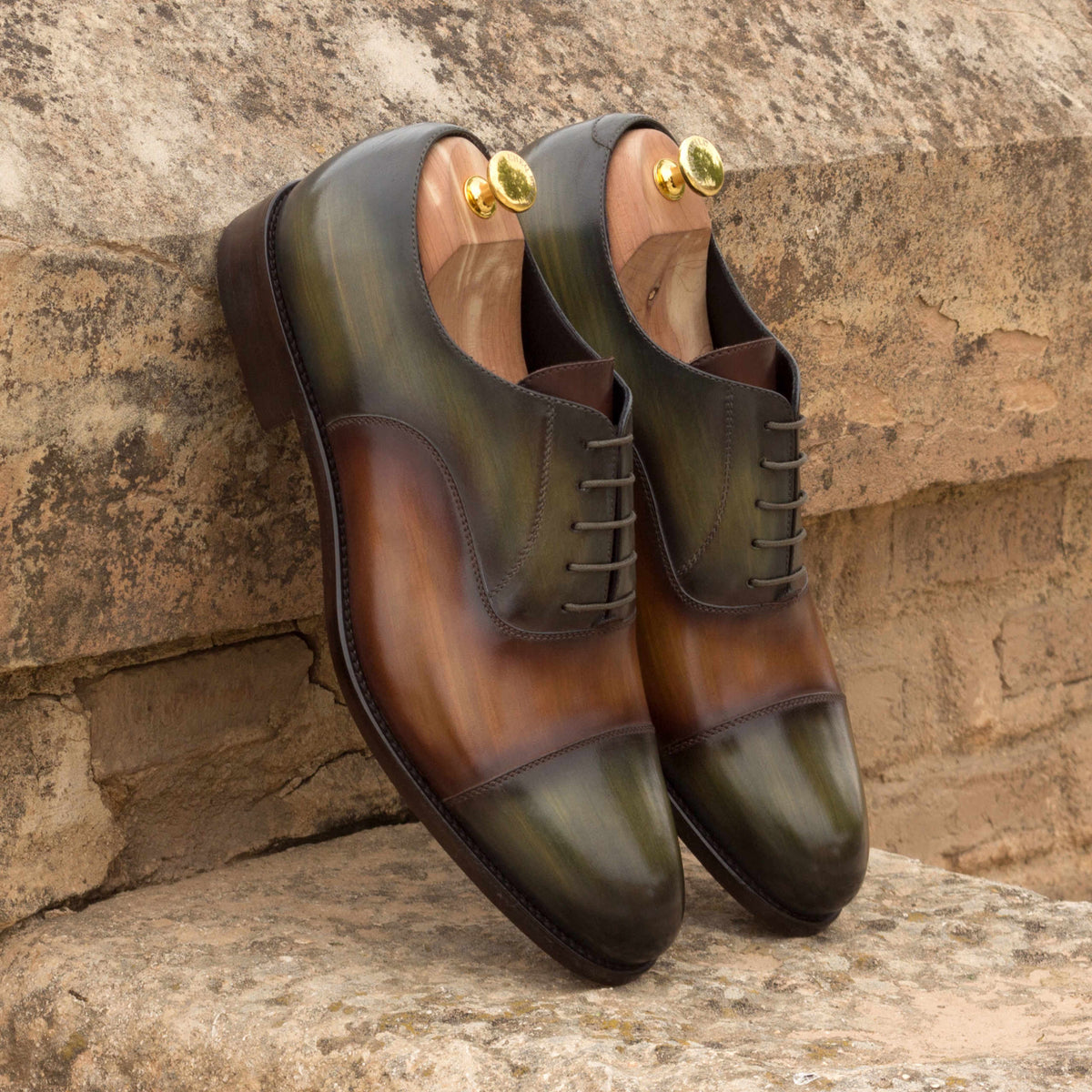
Patina, as a menu option, is not a different hide — it is a finish, applied by hand. The maker layers dyes and burnishes the leather zone by zone, so the pair ships with a built gradient. The cognac-and-khaki oxford in the photograph above runs olive at the collar, warms through the vamp into chestnut, and closes near-black at a high-gloss toe — three zones of one calfskin, each worked to a different depth. No two pairs come out identical, because no two hands burnish identically. That irregularity is not a flaw to be managed; it is the product.
The word carries one genuine confusion, and it is the confusion behind the search itself. Every good calf develops patina naturally — years of flexing, sun and honest polishing deepen the leather into something no factory could spray. A patina finish is that entire story pre-written at the bench. You are buying, in effect, the ten-year shoe on day one: the depth, the zones, the light playing through color, all arriving in the box. Box calf earns its patina over a decade. A patina-finished pair is born mid-story.
How they actually differ, in wear
First impressions run in opposite directions. Box calf reads immediately: one even tone, a clean line of light down the toe, formality visible from across a lobby. Patina reads slowly: the eye takes the shoe as an object before it resolves it as a color, and what it resolves into changes with the light — one way at the morning window, another under evening lamps. That shift is precisely the point.
The two age differently, and this is where the decision gets honest. Box calf wants the ritual — clean, condition, cream, wax, mirror the toe — and repays it; neglect it and the uniform surface shows every miss. A patina finish asks for the opposite: restraint. It was burnished into shape by a professional, and a heavy-handed mirror shine on top of it does not improve the gradient, it flattens it. Neutral cream, a soft cloth, and the confidence to leave well enough alone. Patina is, bluntly, the lower-maintenance leather of the two — one of the quiet reasons men who wear it daily end up devoted to it.
Formality divides them most cleanly of all. Black box calf is the ceiling: courts, funerals, boardrooms, black-tie adjacent. Patina sits one honest step down and one step sideways — fully dressy, completely correct at a wedding or a serious dinner, but always reading character before polish. No patina pair is ever the anonymous shoe in the room. If you need the anonymous shoe, you already know which column you are in.
The verdict, without the hedge
If this oxford is your one pair of serious dress shoes — the shoe that has to cover the funeral, the interview, the ceremony you can't predict — box calf, black or espresso, and the argument is closed. A single pair must be the formal ceiling, and only the uniform finish gets you there.
If you already own the ceiling, the second oxford should be patina, and not as a consolation. A man with the black pair in rotation buys his second oxford for pleasure, and the hand-burnished gradient is the pleasure column: the shoe that gets noticed at the wedding, walks a navy or charcoal suit into character territory, and looks more individual every year you own it. Creative rooms, occasions, evening wear — patina wins everywhere the aim is to be remembered rather than merely correct.
And notice what the question itself reveals: off the rack, you never got to ask it. Every pair on a shop wall carries a leather decision made months ago, in a showroom you never entered, by a buyer whose job was averages. The made-to-order route puts the fork back in your hand — you set the leather and the colorway, watch the spec take shape, and confirm the whole of it before a single piece is cut; the pair is then built once, over about four to six weeks, for one customer and no one else. The full map of that route — silhouette, toe treatment, sole, every decision beyond leather — is our walkthrough of the made-to-order oxford; the leather question is the first door on it, and the design studio is where you open it. The path from spec to doorstep, end to end, is laid out on the order process page.
Straight answers on the two finishes
Is patina a leather or a finish? A finish. Patina-finished shoes are built on the same full-grain calfskin as box calf; the difference is entirely in the surface work — dyes layered and zones burnished by hand at the bench, so the gradient is part of the spec you confirm before anything is cut.
Does box calf develop patina too? Yes — naturally, over years. Flex lines, sun and honest polishing slowly deepen it into rich, earned character of its own. The two arrive at a similar destination by different roads: one grows into the story, the other is born into it.
Which is more formal? Box calf, without argument, and most decisively in black. A patina finish is fully dressy — correct at weddings, dinners, occasions — but it reads individual before it reads formal. Choose the register the pair actually has to work in.
Which one is harder to care for? Box calf, because it asks for the full polishing ritual and shows every shortcut. Patina asks for restraint: neutral cream, a soft cloth, and no attempt to mirror-shine over the maker's gradient, which would only flatten it.
Can I see both finishes before deciding? Yes — the design studio builds the oxford spec on screen, leather and colorway included, before anything is committed. When genuinely torn, build both virtually and let the pair you keep thinking about win.