This week, Google News served the menswear internet a rerun with perfect timing: Forbes' profile of the Italian designer behind Prince Harry's favourite velvet loafers — Alberto Moretti of Arfango — is circulating again a decade after it first ran, and it lands in the middle of the densest velvet-slipper news cycle in years. Gucci is pushing new logo velvet loafers. The Telegraph is coaching readers through black-tie dressing with "luxe velvet loafers and bow ties." Luxury London just rounded up "chic velvet slippers for men," and even Winston Churchill's velvet slippers made the BBC ahead of their auction. When a royal shoe story from 2015 is the freshest thing in the feed, that isn't nostalgia — that's a trend confirming itself. The velvet loafer is back in rotation, and this time the one-of-a-kind pair it has always promised is actually within reach.
Because that was always the tension with this shoe. When Forbes sat down with Moretti in his Milan showroom on Via della Spiga, the whole pitch was scarcity: a family business established in 1902, famous for brown leather loafers through the Sixties and Seventies, relaunched in 2008 around small numbers of velvet ones for "a very niche market," with Barneys holding the exclusive right to sell them in America. "Our client is somebody who has it all," Moretti said, "but is looking for that particular one of a kind piece." The silhouette was everywhere in the coverage; the actual shoe was almost nowhere to be had. The made-to-order answer to that tension is the same one-of-a-kind promise — without the gatekeeping.

The house that velvet rebuilt
The Arfango story is worth knowing, because it explains why velvet loafers keep resurfacing instead of simply going away. The house made its name the traditional way: brown leather loafers, notorious through its mid-century heyday. When Alberto Moretti relaunched the family firm in 2008, he kept the loafer and changed the register — velvet instead of calf, evening instead of everyday — and the relaunch found exactly the clientele you'd expect. Morgan Freeman wore them. Adrien Brody wore them. And then, as Moretti told Forbes: "Prince Harry bought some shoes at the London pop-up store we had some time ago. He got these velvet, laser-cut wing-tip loafers, which we later named after him." A Florentine workshop with a royal namesake is the kind of story this shoe has always traded on — aristocratic, a little theatrical, impossible to manufacture on purpose.
The shoe a prince got named after him
But read that quote again and notice the paradox inside it. The prince walked into a pop-up and bought a pair that already existed — a designer's idea that happened to fit, then got named after him because of who he was. It's the inverse of how a bespoke relationship is supposed to work. The velvet slipper is marketed as the most personal shoe in a man's wardrobe, yet the purchase itself is the least personal thing about it: you choose from whatever velvet, trim and crest the house already offers, and the "one of a kind" part is a story about scarcity rather than construction. Exclusive distribution, small numbers, a niche market — Moretti's own strategy amounts to making sure almost nobody gets the shoe at all. Made to order keeps the promise differently: one pair, built once, to one customer's spec — yours, not a prince's.
Why velvet owns the evening — and the wedding
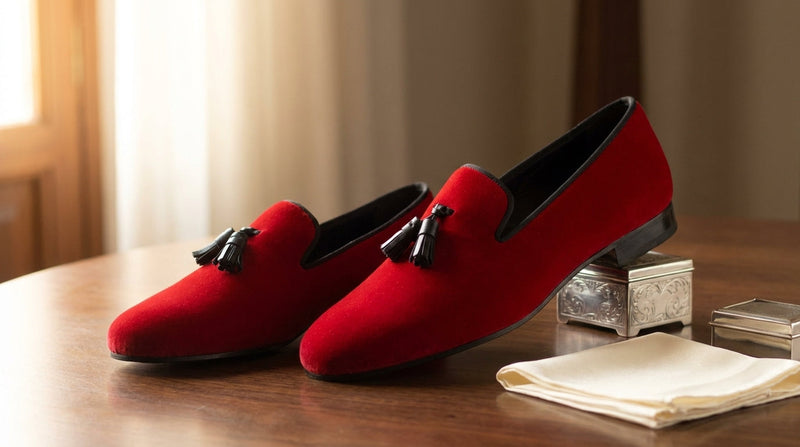
The reason the silhouette keeps winning has nothing to do with royalty. A velvet slipper is structurally an evening shoe: a plush velvet upper, grosgrain piping tracing the collar, a high throat that sits cleanly under a trouser hem, and a thin leather sole that says ballroom, not sidewalk. Under black tie it does everything a patent opera pump does, with more personality; under a midnight-blue dinner suit it is the strongest single move a man can make short of a velvet jacket. Which is why the velvet loafers wedding pairing has quietly become the rare formal trend that photographs well from every angle: grooms build the reception look around it — the same instinct behind our guide to grooms in loafers — and guests wear it to elevate a dinner suit that would otherwise look like everyone else's. If you're building that look now, the made-to-order wedding route lets you match the shoe to the suit rather than the other way around.
The made-to-order answer
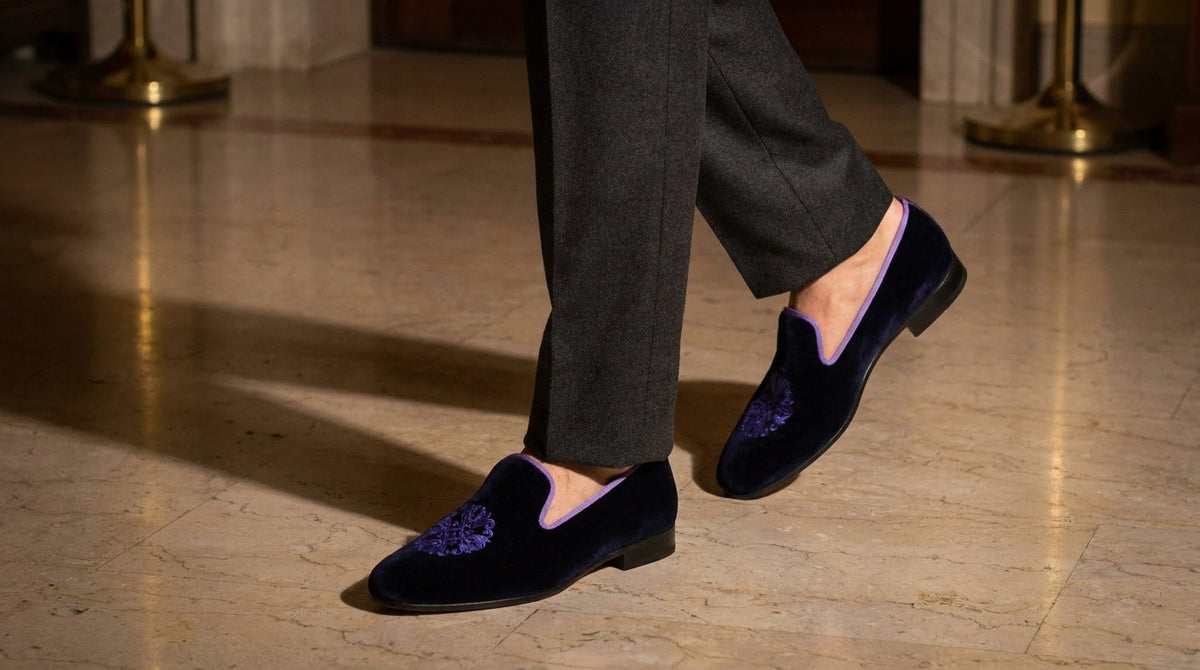
Which brings the story back to this week's feed. The Moretti profile resurfacing matters because the question it posed in 2015 now has a different answer. If the client "has it all but is looking for that particular one of a kind piece," the one of a kind piece no longer has to be a named style in a Milan showroom — it can be the pair you spec yourself. Deep navy velvet, a purple embroidered crest, lavender grosgrain at the collar: exactly the pair in the photograph above, and exactly the kind of spec you set in the design studio before anything is cut. The pair is then made to order over four to six weeks, with the spec confirmed before production begins. The next velvet loafers wedding conversation you're in can start with "I designed these" — which is a better line than "these are the prince's," and one the original story never let anyone have.
Questions people actually ask
Who made Prince Harry's velvet loafers? Alberto Moretti of Arfango — the Italian family firm, established in 1902, that he relaunched in 2008 around velvet loafers. According to Forbes, Prince Harry bought a pair of velvet, laser-cut wing-tip loafers at the house's London pop-up store; the style was later named after him. The brand's velvet following has also included Morgan Freeman and Adrien Brody.
Can you wear velvet loafers to a wedding? Yes — the velvet slipper is an evening-formal shoe, which makes it a natural for black-tie weddings, evening receptions and winter-formal events. The formula that works: velvet upper, grosgrain collar piping, thin sole, worn with a dinner suit or dark formal tailoring. For grooms and grooms' parties, it's strongest as the reception pair; for guests, it's the simplest way to make a standard dinner suit look intentional.
How do I get a one-of-a-kind pair without waiting on exclusivity? The 2015 route was scarcity: exclusive retailers, small numbers, a niche market. The made-to-order route is construction instead — you set the velvet color, the collar trim and the vamp treatment in the design studio, the spec is confirmed before the cut, and the pair is built once, for you, over four to six weeks. One of a kind by design, not by waiting list.