Yes — and not tentatively yes. Of every room a velvet loafer can walk into, black tie is the one where it is not merely allowed but native. The velvet slipper was born in the Victorian smoking room, dressed up with crests and grosgrain, and moved into the evening wardrobe generations before anyone thought of it as a statement. Under a tuxedo it is doing exactly what it was built to do. The question is not whether the pairing works — it is how to make it work like it was always yours.
Start with what black tie actually is: the most specified garment most men will ever wear. The dinner jacket's lapels are faced in satin or grosgrain by design, the trousers carry a silk side stripe, the whole silhouette is an exercise in controlled texture. Patent opera pumps have held the evening-shoe post for a century precisely because they understand the assignment — light, lusterless leg, all the shine concentrated in one deliberate place. A velvet slipper speaks the same sentence in a different accent: matte nap up top, grosgrain at the collar echoing the lapel facing, a thin leather sole that says ballroom, not sidewalk. It is texture answering texture, which is the entire grammar of black tie.

The rules that make it read as heritage, not costume
Three rules carry almost all of the weight. First, colour discipline: keep the velvet dark and saturated. Black, midnight navy, deep burgundy, forest green, a rich aubergine — velvet in these registers behaves like formalwear. Pale or candy velvet reads as house-shoe cosplay under a dinner jacket. Second, let the trim do the talking: a grosgrain binding around the collar, matched to the velvet or set in quiet contrast, is the detail that signals the shoe was designed for evening rather than borrowed from the lounge. Third, mind the break: a slight break or none at all, so the shoe stays visible and the velvet catches light as you move. A trouser hem that swallows the shoe wastes the entire effect.
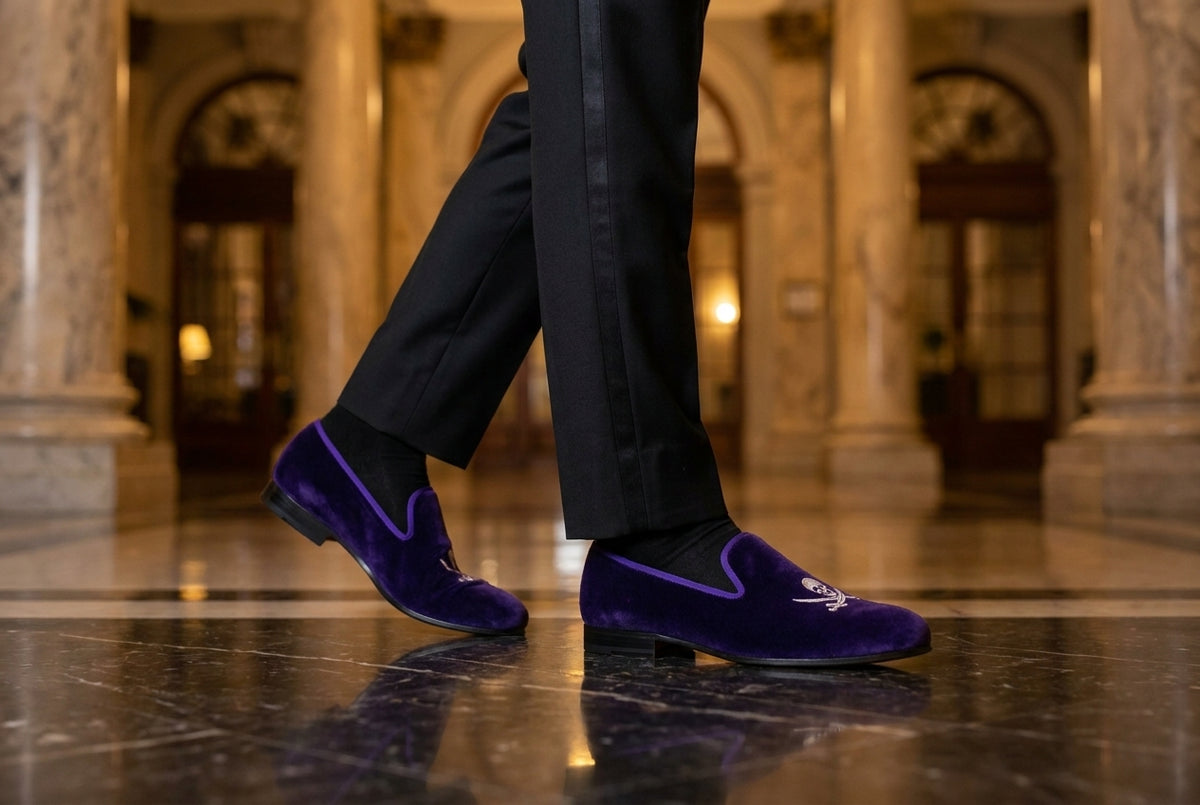
The crest question answers itself with one look at the photograph above. An embroidered emblem — heraldic, nautical, or quietly irreverent — is the slipper's oldest signature, going back to the house codes stitched for gentlemen in their own smoking rooms. Embroidery sits flat and reads as craft; jeweled or metal hardware reads as costume. Plain velvet with a clean grosgrain collar is the most understated route; a crest is the version with a sense of humour kept at ballroom volume.
Where the pairing earns its keep
The obvious rooms: galas, opera nights, black-tie weddings, awards dinners, anywhere the invitation says the dress code and means it. The less obvious one worth claiming: the velvet-dinner-jacket wedding, where a groom in a bottle-green or midnight jacket needs a shoe that matches the jacket's texture logic without matching its fabric — velvet slippers in a contrasting shade do this in one move. It is the same instinct behind our guide to grooms in loafers, and the reason whole wedding parties route their evening-footwear spec through the wedding concierge rather than a shoe rack. As we saw when Prince William's velvet smoking slippers resurfaced in the press, the men who wear this shoe best are the men who treat it as an evening standard, not an event stunt.
The made-to-order advantage at its purest
Here is the thing about wearing velvet loafers with a tuxedo: the tuxedo is already yours, specified to the centimetre — the lapel width, the facing, the break. The one off-the-rag element in the whole silhouette is the shoe. Made to order closes that gap. You set the velvet colour to sit with or against the dinner jacket, the collar trim to echo the lapel facing, the vamp plain or crested — and if you want the pair in the photograph above, that exact spec exists: deep royal-purple velvet, a silver skull-and-crossed-swords emblem, matching purple grosgrain around the collar. The spec is confirmed with you before anything is cut, then the pair is built once, over four to six weeks, in our design studio workflow — one customer, one pair, no rack in between. The velvet house page collects the colourways and constructions worth starting from.
So: can you wear velvet loafers with a tuxedo? You can — and once the colour is dark, the trim is grosgrain, and the crest (if any) is embroidered rather than glued, the pairing stops being a question and becomes the most personal square inch of the entire black-tie uniform. Velvet loafers with a tuxedo aren't the bold move. They're the considered one.
Questions people actually ask
Are velvet loafers formal enough for black tie? Yes. The Albert slipper has been an evening shoe since the Victorian era — velvet upper, grosgrain trim, thin leather sole — and under a dinner jacket it performs the same role as the patent opera pump, with more texture and more personality. Keep the velvet dark and the construction dressy and no one at the door will hesitate.
What colour velvet loafers should I wear with a black tuxedo? Stay dark and saturated: black, midnight navy, deep burgundy, forest green or aubergine all sit correctly under black tie. Bright or pastel velvet drifts into costume. If the jacket is midnight blue rather than black, navy velvet with a contrasting collar trim is the classic move.
Velvet slippers or patent opera pumps for black tie? Both are correct — they trade blows on the same axis. The opera pump is the more anonymous classic; the velvet slipper is the one that lets you specify texture, trim and a crest of your own. Under a plain black rig the slipper adds the personal note; under a heavily detailed rig the pump keeps things quiet.
How do made-to-order velvet slippers work? You set the spec in the design studio — velvet colour, collar trim, vamp treatment — the spec is confirmed with you before production, and the pair is then built once, to that spec, over four to six weeks. Nothing is cut until you have signed off on exactly what is being made, which is how a black-tie shoe ends up matched to the jacket it will live under.