Black Velvet Loafers: The Honest Buyer's Guide
Black velvet loafers sit at a strange intersection. They are evening shoes that masquerade as day shoes. They are slippers that pretend to be streetwear. The honest truth is that most men buy them for one black-tie invitation, they wear them once, then watch them gather dust in a closet for years.
This guide exists because the category deserves better than that cycle. Velvet, when handled correctly, is one of the most durable and expressive materials in menswear. The problem is not the fabric. The problem is that nearly every black velvet loafer on the market is built for a price point, not for a life.
What Velvet Actually Is
Velvet is a warp-pile fabric. The surface you touch is a forest of cut loops standing perpendicular to the base weave. That pile catches light differently at every angle, which is why velvet shifts from flat black to deep charcoal to something almost metallic depending on how you stand. It also means the nap direction matters. Run your hand against the grain and the color darkens. With the grain and it lightens. A well-made velvet shoe cuts all pattern pieces from the same bolt with the nap running in one consistent direction. Cheap versions do not bother. The result is a shoe that looks like two different colors depending on which foot you are looking at.
The Construction That Separates Keepers From Landfill
Most black velvet loafers you will find under three hundred dollars use a cemented construction. The upper is glued to a rubber or plastic sole. No welt, no stitching you can see, no path to a resole. When the sole separates, and it will, the shoe is done. A Goodyear-welted velvet loafer costs more upfront but returns that money over a decade of wear. The welt is a strip of leather stitched to both the upper and the insole. The sole is then stitched to the welt. When the sole wears out, a cobbler unstitches it and puts a new one on. The upper stays intact. The shoe stays yours.
Blake construction is the middle ground. The sole is stitched directly through the insole. It is lighter and more flexible than Goodyear. It can be resoled, but fewer cobblers have the machine for it. If you live near a competent shoe repair shop, Blake is a legitimate option. If you do not, default to Goodyear.
The Slipper Trap
Here is where most buyers go wrong. They see "velvet loafer" and imagine a smoking jacket, a glass of whiskey, a fireplace. They buy a shoe with a quilted silk lining, a paper-thin leather sole, and zero structure in the heel counter. That is a slipper. It belongs on a carpet. If you walk two blocks on wet pavement in it, the sole saturates, the heel collapses, and the velvet stains in ways that never come out.
A real velvet loafer has a leather sole with a rubber forepart insert, or a full leather sole with a proper stacked heel. It has a structured heel counter that holds your foot. The lining is leather, not silk. The vamp is cut high enough to grip the instep. You can wear it to dinner. You can wear it to a wedding. You can walk home in it if the car does not show up.
Style Families Worth Knowing
Belgian Slipper
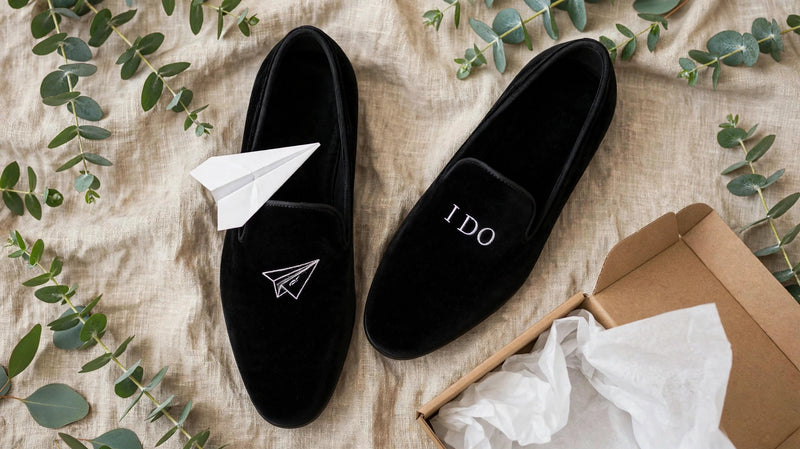
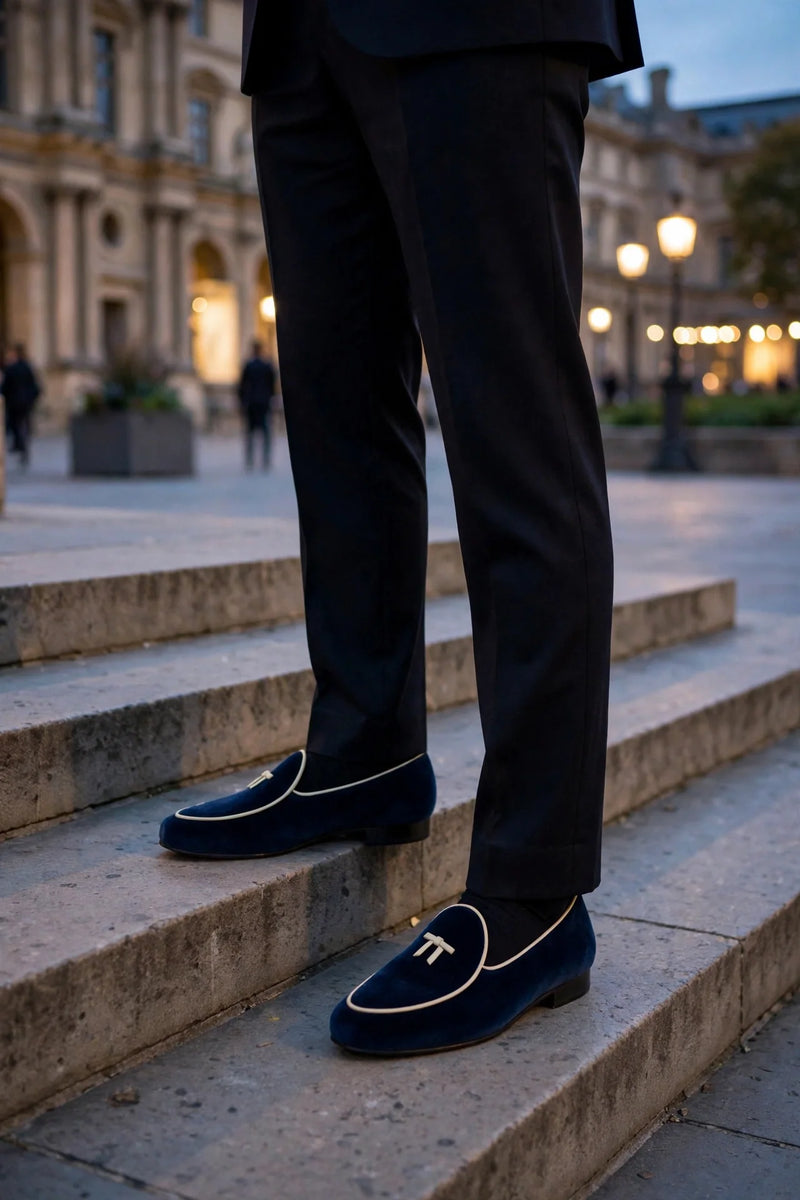
The Belgian slipper is the purist choice. No tassels, no penny strap, no hardware. A single vamp flap covers the toe area, trimmed in contrasting piping, usually cream or off-white leather. The throat is low. The sole is thin. It is the closest thing to a dress slipper that still functions outdoors. Our customizer offers this in black velvet with your choice of piping color and monogram placement.
Tassel Loafer
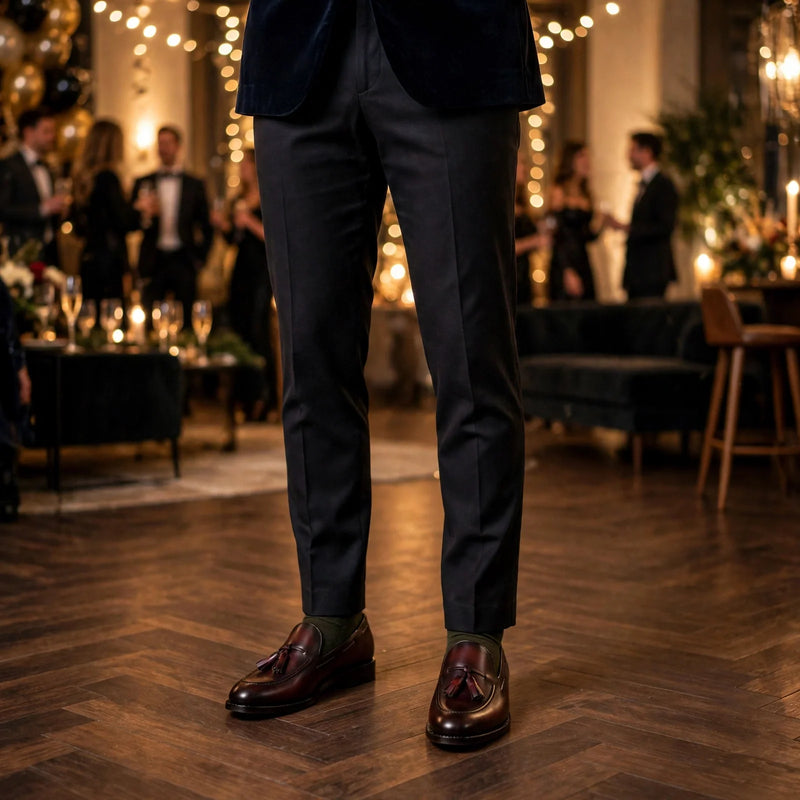
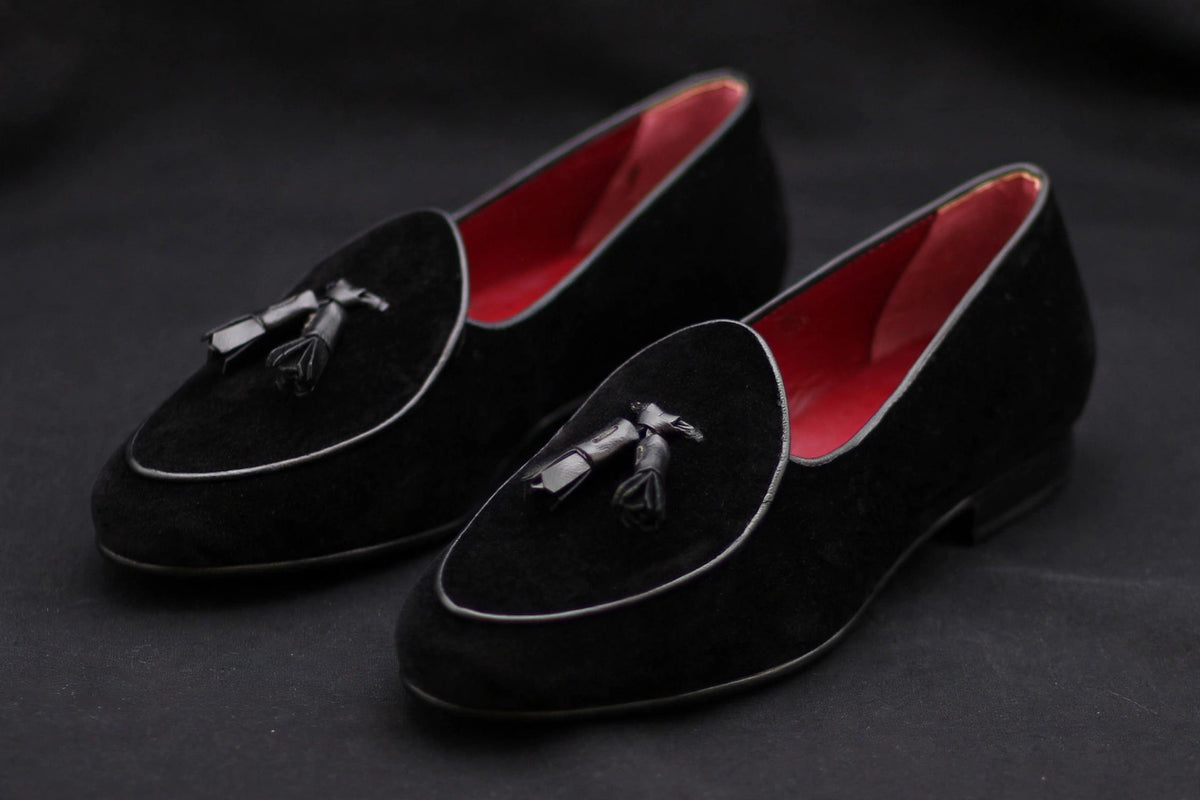
The tassel loafer adds a knot-and-fringe detail at the vamp center. It reads more traditional, more Ivy League. The tassel hides the vamp seam and adds visual weight. In black velvet it can veer toward costume if the tassels are oversized. Ours are proportioned for the last, substantial but not theatrical.
Horsebit Loafer
The metal bar across the vamp. In black velvet the hardware becomes the focal point. Choose brushed brass for warmth, palladium for cool neutrality. The horsebit also locks the fit, the vamp cannot stretch open because the bit holds it. That makes this the most secure slip-on in the lineup.
Driver / Moc-Toe
The reference image for this article shows a driver silhouette: high throat, binding trim, rubber studded sole. This is the most wearable velvet loafer for daily life. The rubber sole grips wet pavement. The binding protects the throat edge from fraying. The high throat holds the foot without laces. It is the only velvet loafer you could plausibly wear to the office on a Tuesday.
Sizing Velvet: The Hidden Variable
Velvet has give. Leather stretches. The combination means a velvet loafer will fit differently after ten wears than it did out of the box. The standard advice, size down half a size from your dress shoe, works for unlined, unstructured slippers. It fails for structured, lined, Goodyear-welted pairs. The only reliable method is to measure your foot against the last specifications. Our customizer reveals each style's size range at the size selection step before your order is confirmed. Size 17 and 18 are available on the right styles. We offer D and EE widths. The lasts are scaled, not stretched.
Care That Actually Works
Brush after every wear. A soft horsehair brush, with the nap. This lifts dust before it embeds. Steam once a month, hold the shoe over a kettle spout for ten seconds per side, then brush while warm. This revives crushed pile. Never use liquid cleaners on velvet. They mat the nap permanently. If you get a stain, take it to a specialist who works with pile fabrics. Do not experiment.
Store with cedar trees. They absorb moisture and hold the shape. If you rotate three pairs, each gets forty-eight hours of rest between wears. That is the single biggest factor in whether a velvet loafer lasts three years or thirty.
When to Choose Custom
Off-the-shelf black velvet loafers exist in three tiers: disposable fashion, decent mid-range, and bespoke-adjacent. The middle tier disappears fast, brands discontinue, SKUs shift, the pair you liked last year is gone this year. Custom solves this. You specify the last, the width, the piping color, the sole type, the monogram. You get a shoe that fits your foot, not a statistical average. The lead time is four to six weeks. The shoe arrives made for you. That is the value proposition.
What to Wear Them With
Black velvet loafers want contrast. Grey flannel trousers. Midnight blue wool. Cream cavalry twill. Dark denim with a structured blazer. Avoid black trousers, the texture difference reads as a mismatch, not a match. White tie and black tie both work. Business formal does not. The shoe is too expressive for a navy worsted suit. Save it for the occasions that warrant expression.
FAQ
Can you resole a velvet loafer?
Yes, if it is Goodyear-welted or Blake-stitched. Cemented soles cannot be resoled.
Does velvet stretch?
The pile compresses. The backing leather stretches slightly. A lined, structured shoe holds its shape well.
What width do you offer?
D and EE widths. The size selection step shows what is available for your chosen style.
Can I get a monogram on velvet?
Yes. Hand embroidery on velvet and suede. Custom insignia print on sneakers. Initials via the design studio.
How long does production take?
Four to six weeks for made-to-order. Staple styles in standard sizes can ship in forty-eight hours.
What sole is best for wet weather?
Leather sole with a rubber forepart insert, or the driver's rubber studded sole.
Build your black velvet loafer in the customizer | See the velvet Belgian loafer landing page